




Same packet of freeze-dried coffee, same amount of powder, same water source yet brew it hot and you get warm floral and caramel notes, brew it cold and you suddenly get smooth chocolate and a noticeably gentler sweetness. It’s not an illusion, and it’s not psychological. This is one of the most fascinating phenomena in the science of taste and once you understand it, you’ll know exactly which way to brew depending on the moment and the mood.
The science behind how temperature changes coffee’s flavor
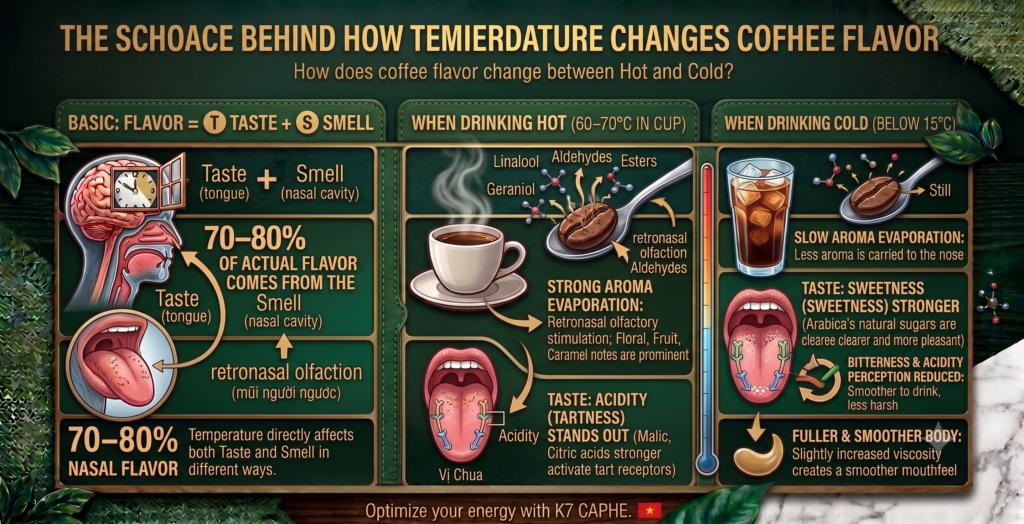
Before comparing hot and cold, there’s a foundational point worth understanding: the flavor of coffee or any drink doesn’t come from the tongue alone. It comes from the combination of taste and smell. Scientists estimate that most of what we call “flavor” actually comes from the nose — specifically from the stream of vapor that travels backward from the throat into the nasal cavity as you drink, known as retronasal olfaction.
And here’s the key point: temperature directly affects both of these channels in completely different ways.
When served hot (60–70°C in the cup)
At around 60–70°C in the cup (roughly 50–55°C by the time it reaches your mouth), the higher heat makes aromatic compounds evaporate more strongly linalool, geraniol, esters, and aldehydes rise quickly, travel into the nasal cavity via the retronasal route, and stimulate your sense of smell clearly. That’s why hot coffee smells “stronger” both when you bring it to your nose and on your first sip. Floral, fruity, and caramel notes are most clearly perceived at this temperature.
On top of that, at higher temperatures, acidity (bright tartness) also stands out more because organic acids like malic and citric acid stimulate the tongue’s sour receptors more strongly when hot.
When served cold (below 15°C)
Lower temperatures slow down the evaporation of aromatic compounds meaning less aroma actually rises to your nose. But in exchange, sweetness is perceived more strongly at cold temperatures a phenomenon well documented in taste physiology research. The natural sugars in Arabica, which are partly masked by heat and aroma when served hot, suddenly become clearer and more pleasant when cold.
At the same time, bitterness and acidity are perceived less strongly at cold temperatures which explains why many people find cold coffee easier to drink and less harsh, even using the exact same amount of powder.
One more factor: at cold temperatures, the solution’s viscosity increases slightly, creating a fuller, smoother sensation on the tongue even when nothing has actually been added.
Head-to-head: K7 CAPHE’s flavor hot vs. cold
Applying that science to a real cup of K7 CAPHE freeze-dried Arabica:
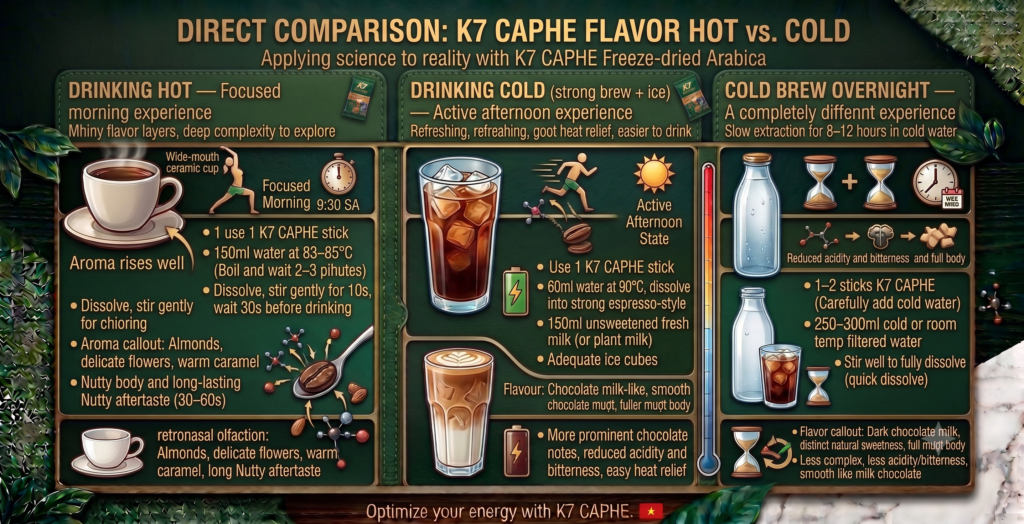
Hot — the focused-morning experience: The moment it dissolves, the aroma rises clearly lightly roasted almond, a subtle hint of white flowers, warm caramel. As you drink, your tongue picks up natural sweetness first, followed by the gentle, signature acidity of Cầu Đất Arabica, then a medium body from Đắk Lắk Robusta that holds the flavor together. A nutty finish lingers for 30–60 seconds after each sip. This is the cup for focus — layered, complex, and best suited to an unhurried morning when you actually have time to savor it.
Cold (brewed strong + ice) — the energetic-midday experience: Less aroma escapes, but the moment it hits your tongue, Arabica’s natural sweetness comes through much more clearly almost as if sugar had been added, though none has. The bitterness softens, the acidity nearly disappears. Chocolate notes from Đắk Lắk Robusta become more prominent when cold, creating a smooth, refreshing feel. This is the cup for refreshment — less complex than the hot version, but easier to drink, great for cooling down, and perfect for a sunny midday in Saigon or a June afternoon in Hanoi.
Overnight cold brew — a completely different experience: This isn’t just “cold coffee” it’s an entirely different flavor product. When extracted slowly in cold water over 8–12 hours, compounds dissolve through a completely different mechanism than with hot water: less acidity, less bitterness, more sweetness, and a fuller body. The result is a cup of K7 CAPHE cold brew that tastes as smooth as milk chocolate no harshness, no sourness, just natural sweetness and a full body. Many people trying cold brew for the first time don’t even realize it’s coffee, because it’s just that easy to drink.
4 ways to brew one packet of K7 CAPHE
Same packet, four completely different experiences just by changing the water temperature and brewing method.
Recipe 1 — Hot: pure hot coffee
Best for: an unhurried morning, deep focus work, or cool weather
- 1 K7 CAPHE freeze-dried stick
- 150ml water at 83–85°C (boil, then wait 2–3 minutes)
- Dissolve, stir gently for 10 seconds, wait 30 seconds before drinking
- No sugar the first time, to taste the true flavor
- Use a white porcelain cup with a wide mouth for the best aroma
Dominant flavors: almond, caramel, light white flowers, a long nutty finish
Recipe 2 — Iced: the classic iced coffee
Best for: a hot midday, a quick refreshment, ready in 5 minutes
- 1 K7 CAPHE freeze-dried stick
- 80ml water at 90°C (brewed stronger to compensate for dilution as ice melts)
- Dissolve completely
- Pour immediately over 120–150g of ice in a tall glass
- Stir gently and drink right away
Dominant flavors: light chocolate, natural sweetness, refreshing, low acidity
Recipe 3 — Iced latte: a healthier iced coffee with milk
Best for: an afternoon that needs sustained energy, something a bit “fuller”
- 1 K7 CAPHE freeze-dried stick
- 60ml water at 90°C, dissolved into a strong, espresso-style shot
- 150ml unsweetened fresh milk (or plant-based milk, to taste)
- Ice, as needed
- Slowly pour the milk over the coffee to create layers — stir before drinking
Dominant flavors: milky caramel, smooth chocolate, full body, natural sweetness
Recipe 4 — Cold brew: the weekend experience
Best for: a relaxed weekend, prepared ahead of time, sipped slowly
- 1–2 K7 CAPHE freeze-dried sticks
- 250–300ml cold or room-temperature filtered water
- Stir until fully dissolved (freeze-dried powder dissolves very quickly, no need for the long steeping time regular ground coffee requires)
- Refrigerate for 8–12 hours
- Pour into a glass, add ice if you like no straining needed
Dominant flavors: rich milk chocolate, pronounced natural sweetness, smooth full body, almost no sourness or bitterness
So which one tastes “better”?
The honest answer: no single method tastes better there’s only the method that fits you best at that particular moment.
If you want to explore K7 CAPHE’s most complex flavor, experiencing the full layers Cầu Đất and Khe Sanh Arabica can offer drink it hot, black, in a quiet early morning.
If you want a delicious, easy-drinking, cooling cup that doesn’t require much thought an iced latte or cold brew is the perfect choice.
What’s truly interesting is that the exact same box of K7 CAPHE can give you four completely different experiences no extra purchase, no extra equipment, just a change in water temperature and brewing method. That’s a level of flexibility few coffee products can offer.
Frequently asked questions
Is hot or cold coffee better for your health? Nutritionally, there’s no meaningful difference the same packet of coffee delivers the same amount of caffeine and nutrient compounds whether brewed hot or cold. The choice should come down to flavor preference and occasion (weather, time of day) rather than health factors.
Why does cold coffee taste sweeter than hot coffee? Because at lower temperatures, the tongue perceives sweetness more strongly while bitterness and acidity are perceived less strongly a well-documented taste-physiology phenomenon, not because cold coffee actually contains more sugar.
How is cold brew different from regular iced coffee? Regular iced coffee is brewed strong with hot water, then poured over ice to cool quickly. Cold brew is extracted slowly, directly in cold water, over 8–12 hours, producing an entirely different dissolution process less acidity, less bitterness, more sweetness, and a fuller body.
How much water and milk do I need for an iced latte? The basic recipe: dissolve 1 K7 CAPHE stick in 60ml of 90°C water to make a strong coffee base, then add 150ml of unsweetened fresh milk and ice as needed.
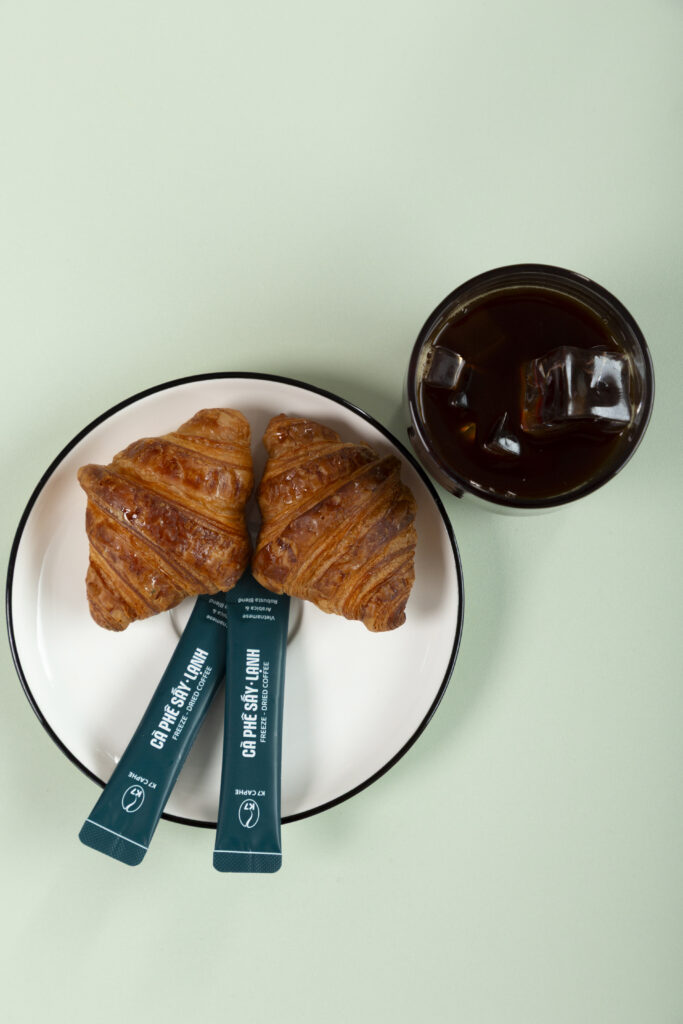
One box of K7 CAPHE, four completely different experiences
Have you tried all four brewing methods yet? Hot, Iced, Iced Latte, Cold Brew each one is a new discovery from the very same stick of freeze-dried coffee.
K7 CAPHE freeze-dried coffee, Vietnamese Arabica (Cầu Đất & Khe Sanh) blended with Đắk Lắk Robusta. No additives, no flavoring. Flexible for every way you like to drink it, delicious at every temperature.
Domestic customers: Order now via our website or e-commerce platform: Buy now — K7 CAPHE on Shopee
International customers: Please reach out to us directly: Contact K7 CAPHE
