




Coffee cupping at home is the technique that Q-Graders holders of the world’s toughest coffee certification use to evaluate flavor systematically. A Q-Grader must pass 22 exams on smell, taste, and professional knowledge, with a pass rate of only around 30%; fewer than 5,000 people worldwide hold this certification. The good news: the cupping technique they use can be learned and applied at home in 10 minutes. And once you know it, you’ll never drink coffee “on autopilot” again.
What is coffee cupping, and why does it change the way you drink coffee forever?
Coffee cupping is the standardized coffee-evaluation method developed by the SCA, the Specialty Coffee Association, the world’s largest professional coffee organization. It’s the common language every coffee professional on the planet uses to describe, compare, and score the quality of a coffee lot.
When a coffee farm in Ethiopia wants to know its lot’s Q Score, it holds a cupping session. When a roaster wants to pick the best beans for a new season, they cup. When a cup scores 90+ in an international competition, that’s the result of serious cupping sessions run by Q-Graders.
But why should you someone who just drinks coffee at home care about any of this?
Because cupping isn’t only an expert’s technique. It’s actually the most systematic way to train your palate and sense of smell, helping you “unlock” a flavor-perception ability everyone has but few people know how to use. After a few cupping sessions at home, you’ll start noticing the almond notes in K7 CAPHE, telling the bright acidity of Arabica apart from the harsh sourness of poorly brewed coffee, and sensing why the lingering aftertaste of high-quality cold-dried coffee differs so much from instant coffee.
Once you’ve “seen” those layers, you can’t unsee them and that’s exactly what makes cupping addictive.
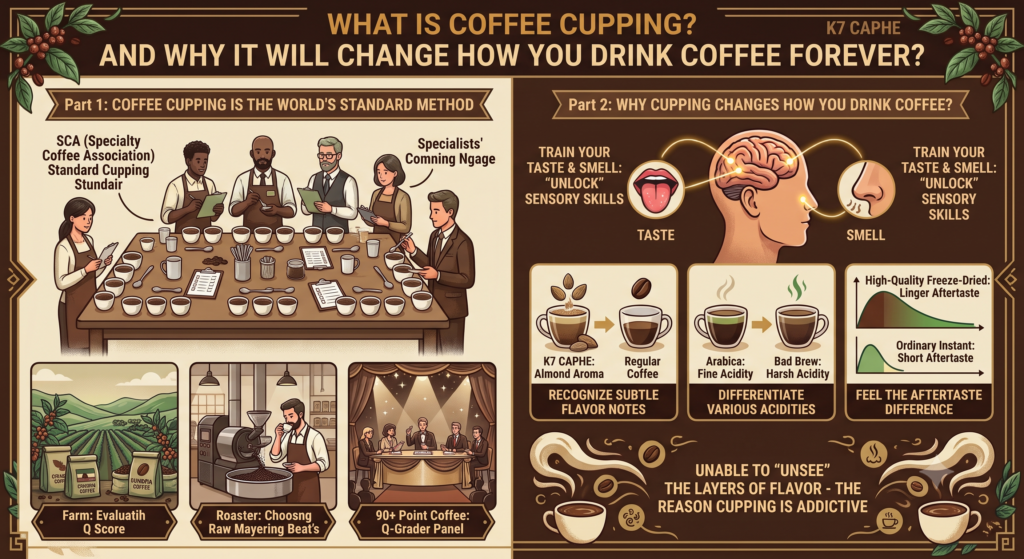
What you need, everything is already in your kitchen
One reason cupping is often assumed to be “for experts only” is that people think it requires special equipment. It doesn’t.
| Equipment | Description / notes |
|---|---|
| A round, deep-bowled spoon | A regular soup spoon works fine. A shiny, odorless metal spoon is ideal avoid plastic spoons, which can hold onto smells. |
| An odorless white cup with a wide mouth | A plain white porcelain cup, no pattern, no logo cup color affects flavor perception (see Topic 10 for more). A wide mouth lets aroma rise and makes it easier to bring your nose close. |
| Water at 93°C (199°F) | Higher than the ideal brewing temperature for drinking (83–85°C / 181–185°F). In cupping, 93°C extracts the coffee’s full flavor including its flaws for the most complete evaluation. This isn’t the tastiest way to brew; it’s the way to “see” the whole profile. |
| Paper towels | For wiping the spoon between samples if you’re cupping several coffees at once. |
| A spit cup (optional) | Professional cuppers don’t swallow every sample since they may taste 20–30 in one session. At home, with 1–2 samples, swallowing is perfectly fine. |
| An SCA Flavor Wheel | A circular chart with hundreds of flavor-description words, arranged from general to specific from “fruity” to “berry” to “blueberry.” Search “SCA Coffee Flavor Wheel” on Google, download it for free, and print it out or save it on your phone. |
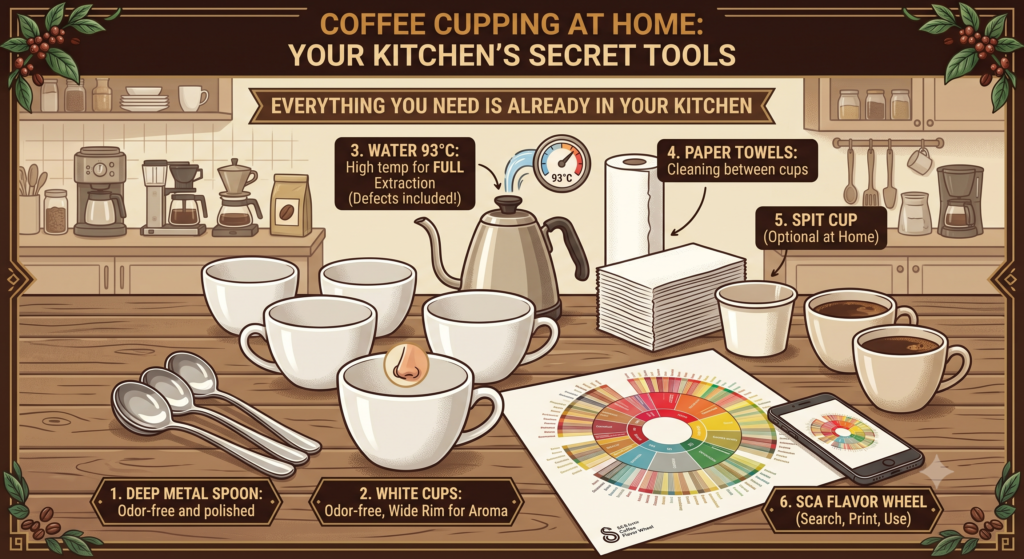
5 steps to cup coffee at home: the process, step by step
A complete cupping session takes about 10–15 minutes. Do it alone or with friends to compare notes cupping in a group is much more fun, since everyone “discovers” different notes.
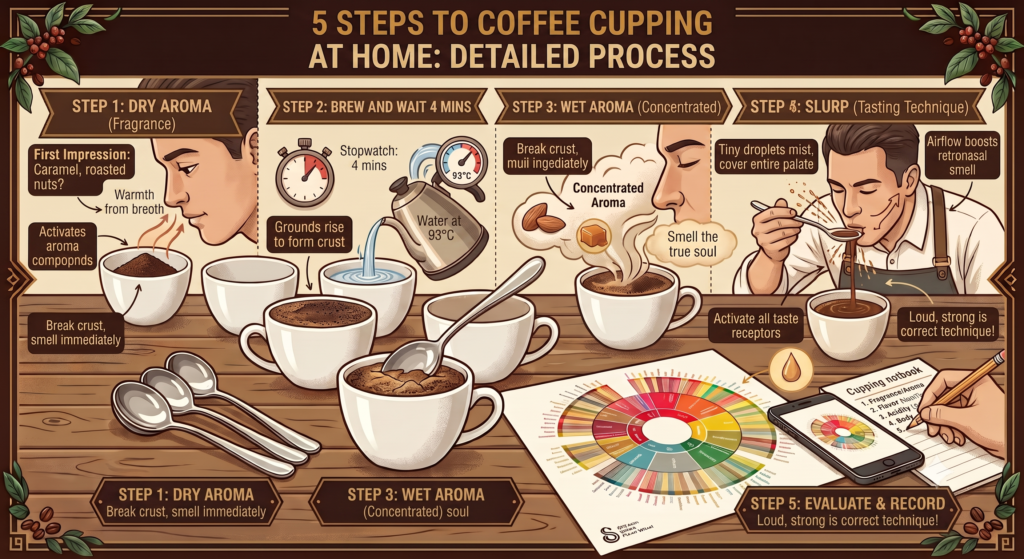
Step 1 — Dry fragrance: before the water touches the grounds
Add ground coffee to the cup (about 8–10g per 150ml of water). Bring your nose close to the rim, exhale gently into the cup, then inhale right away the warmth of your breath helps release the aromatic compounds.
Note your first impression don’t overthink it, just write down whatever you “see” in that first second. Caramel? Roasted nuts? Chocolate? There’s no wrong answer here it’s your own perception.
Step 2 — Brew and wait 4 minutes: don’t stir
Pour 93°C water into the cup, making sure all the grounds are evenly wet. Set a timer for 4 minutes. Don’t stir, don’t touch it let the grounds float up and form a “crust” on the surface. This is an essential part of the process.
While you wait, observe the floating crust its color, its thickness. A fresh, high-quality lot will form a crust that puffs up slightly as CO2 is released.
Step 3 — Wet aroma: break the crust and smell immediately
This is the moment many people call “the best part of cupping.” Using your spoon, gently push the crust down from one side of the cup and the instant it breaks apart, bring your nose in right away to catch the rising aroma.
That burst of steam lasts only a few seconds before it dissipates but in those few seconds, you’ll smell the true “soul” of the cup: concentrated aroma that hasn’t been diluted or driven off by heat. With K7 CAPHE, this is when roasted almond, caramel, and sometimes a hint of white flowers come through most clearly.
Write down what you smell right away this impression will differ from Step 1, and that’s normal and interesting to compare.
Step 4 — Slurp: the loud-sipping technique Q-Graders use
This is the step that looks the strangest but it has a perfectly clear scientific reason behind it.
Scoop up a small amount of coffee (about 8–10ml), bring the spoon close to your lips, and slurp it in hard and fast so the coffee sprays into fine droplets and spreads evenly across your entire tongue and palate at once.
Why? Because different areas of the tongue are sensitive to different tastes and when you drink normally, coffee touches the front of the tongue first. Slurping ensures all your taste receptors fire at the same time, giving you the fullest possible read on the flavor profile. At the same time, the burst of air that comes with a hard slurp pushes aroma up into your nasal cavity through the retronasal route significantly enhancing the flavor experience.
Don’t hold back on the noise a loud slurp is the correct technique here, not bad manners, in a cupping context.
After slurping, exhale slowly through your nose while the coffee is still in your mouth this is when retronasal olfaction does its best work.
Step 5 — Evaluate and record: build your own flavor vocabulary
After slurping and swallowing (or spitting), spend 30–60 seconds sensing and recording across 6 criteria:
| Criterion | Question to answer |
|---|---|
| Fragrance/Aroma | Does the smell change before and after brewing? What do you notice? |
| Flavor | What’s the overall taste when you drink it? Sweet, sour, bitter, salty, in what proportion? |
| Acidity | Is there acidity? If so, is it bright and pleasant (good) or harsh and sharp (not good)? |
| Body | Does the coffee feel heavy or light on the tongue? Smooth or rough? |
| Aftertaste | After swallowing, how long does the flavor linger? Is it pleasant? |
| Balance | Do all the elements above work together, or is something “overpowering” the rest? |
Flavor layers to look for when cupping K7 CAPHE
When applying cupping to K7 CAPHE cold-dried coffee, here are the notes to look for based on the bean profile:
| Origin | Signature flavor |
|---|---|
| Cầu Đất Arabica | Subtle white flowers, roasted almond, light caramel, occasionally a hint of citrus |
| Khe Sanh Arabica | Fuller body, light chocolate, warm earthy notes |
| Đắk Lắk Robusta | Thick crema, balanced bitterness, a strong body that anchors the blend |
Frequently asked questions about coffee cupping
What is coffee cupping? Coffee cupping is the standardized coffee-evaluation method developed by the SCA (Specialty Coffee Association), used to systematically describe, compare, and score coffee quality used by farms, roasters, and international competition judges alike.
How long does home cupping take? A complete session takes about 10–15 minutes, and you can do it alone or with friends to compare impressions.
What equipment do I need? Just a regular soup spoon, a wide-mouthed white porcelain cup, 93°C water, and paper towels no expensive specialized gear required (see the equipment table above).
Why brew at 93°C for cupping when normal brewing is only 83–85°C? The higher temperature extracts the coffee’s full flavor, including its flaws, for the most complete evaluation of the profile this isn’t the tastiest way to brew for drinking, but the way to “see” the whole flavor.
Do I have to swallow the coffee when cupping? No. Professional Q-Graders usually spit it out since they may taste 20–30 samples in one session, but at home with 1–2 samples, swallowing normally is completely fine.
Can beginners cup coffee on their own? Yes. There’s no “wrong” answer when it comes to smelling and recording your first impression cupping is a gradual process of training your palate and sense of smell, and anyone can start right at home.
K7 CAPHE cold-dried coffee, Vietnamese Arabica from Cầu Đất & Khe Sanh, blended with Đắk Lắk Robusta. Its original flavor is fully preserved through freeze-drying technology complex enough to explore through cupping, convenient enough to brew in 30 seconds every morning.
Domestic customers: Buy now on our website or on e-commerce platforms: Buy now — Shopee K7 CAPHE
International customers: Please contact us for assistance: Contact K7 CAPHE
