




You just spent money on a high-quality freeze-dried coffee Arabica from good land, freeze-drying technology preserving the flavor, no additives. Then you pour boiling water straight from the kettle over it. And you wonder why the cup doesn’t taste as good as you expected. The answer isn’t the product it’s the water temperature you just used.
A surprising truth: boiling water is a silent saboteur
Most Vietnamese people grow up with one habit: whenever you want to make coffee, tea, or anything else, you just boil the water and use it. Simple, convenient, and boiling feels “safe.” But with coffee especially high-quality freeze-dried coffee this habit is quietly destroying the flavor you paid for.
The issue isn’t that the temperature is too low or too high in some general sense. The issue is that every degree between 80°C and 100°C affects each chemical component in coffee differently and not every component reacts well to high heat.
To understand why, we need to look inside a cup of coffee at the molecular level.
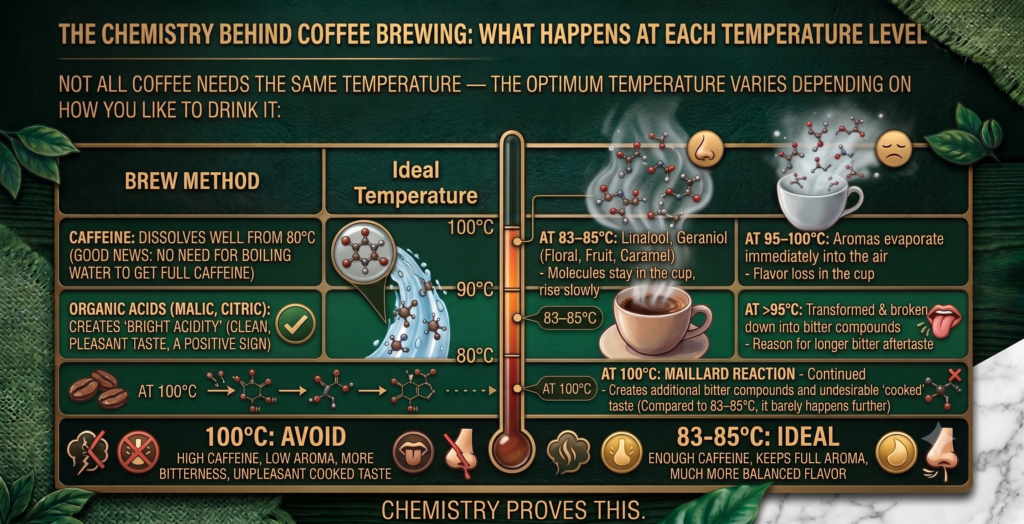
The chemistry behind brewing temperature: what happens at each heat level
Caffeine: Dissolves well starting at 80°C no need for boiling water. That’s good news: you can extract all the caffeine you need without ever reaching 100°C.
Aromatic compounds: This is where the problem starts. Linalool, geraniol, and the esters and aldehydes that create Arabica’s floral, fruity, and caramel notes are all molecules that evaporate easily at high temperatures. At 83–85°C, they dissolve into the water and stay in the cup, rising slowly as you bring the cup to your nose. At 95–100°C, they evaporate into the air almost instantly meaning you no longer get to enjoy them in the cup.
Beneficial organic acids (malic acid, citric acid): At moderate temperatures, these create “bright acidity” the gentle, pleasant tartness of high-quality Arabica, considered a mark of quality. At excessive temperatures (95°C and above), they break down into other compounds with a harsh, unpleasant bitterness which is why coffee brewed with boiling water often has a longer bitter aftertaste.
Over-extraction: At 100°C, water doesn’t just dissolve the flavors you want it also extracts more strongly the compounds responsible for harsh bitterness and an unwanted “overcooked” taste, which exist in small amounts in roasted coffee. At 83–85°C, extraction happens more slowly and selectively, capturing most of the desired flavor without pulling out these unwanted compounds.
In short: 100°C gives you plenty of caffeine, but less aroma, more harsh bitterness, and an unpleasant “overcooked” taste. 83–85°C gives you enough caffeine, preserves the full aroma, and delivers a far more balanced flavor.
Why is freeze-dried coffee more temperature-sensitive than regular coffee?
This is an important fact many people don’t know and it explains why freeze-dried coffee brewing guidelines differ from those for phin or machine-brewed coffee.
During freeze-drying, aroma gets “packed” in the form of microscopic crystals essentially frozen within the coffee powder’s structure. When you dissolve freeze-dried coffee in water, what’s actually happening is that the water “releases” those aromas from the crystal structure and dissolves them into the solution.
At 83–85°C, this release happens fast enough for the flavor to dissolve into the water and gently enough that the volatile compounds don’t shoot straight into the air, staying in the cup instead.
At 100°C, boiling water creates a strong thermal convection current the instant it touches the coffee powder. This “pushes” the volatile flavor compounds out of the solution too quickly they escape into the air before they have time to dissolve into the water and reach your mouth. The result: you smell a strong aroma right as you brew, but the taste ends up flatter and more bitter than expected.
This isn’t a flaw in the product it’s basic physics. And once you understand this, you hold the key to making sure every cup of K7 CAPHE tastes exactly as good as freeze-drying technology can deliver.
How to gauge water temperature without a thermometer
Not everyone has a food thermometer in their kitchen and you don’t actually need one to brew great coffee. Here are three simple, field-tested methods:
- Method 1 — Boil, then wait: Bring water to a full boil, turn off the heat, and wait 2–3 minutes. Depending on the water volume and kettle type, the temperature will drop to around 83–87°C right in the ideal range. Wait an extra minute if you want it slightly cooler.
- Method 2 — Watch for small bubbles: As you heat the water, watch the bottom of the pot. When small bubbles start rising steadily but it’s not yet a rolling boil (no bubbling sound), the temperature is around 80–85°C. That’s your moment to turn off the heat and brew.
- Method 3 — Pre-warm the cup: Pour a little boiling water into the cup, swirl it around, and pour it out. The cup warms up by absorbing roughly 3–5°C from the boiling water, while the remaining water in the kettle cools by about 3–5°C from its boiling point. Combined, you get a cup of coffee at the ideal temperature without any measuring at all.
Bonus tip: why should you pre-warm the cup before brewing?
This is a step many people skip but professional baristas never forget it.
When you pour hot water into a cold cup, straight from the cabinet or sitting at room temperature (around 25–28°C in Vietnam), the cup wall absorbs heat from the water almost instantly in the first few seconds. Depending on the cup material, the water temperature can drop an additional 3–8°C within the first 10 seconds enough to push the brewing temperature from the ideal 83–85°C range down below 80°C, where caffeine and aroma are no longer extracted optimally.
The solution is simple: rinse the cup with hot water for 15–30 seconds before brewing. Pour a little boiling water in, swirl it so it touches every part of the cup’s inner wall, then pour it out. The cup is now close to the brewing water’s temperature and when you pour in your coffee, the temperature stays stable throughout your drinking experience.
One more small tip: a thick porcelain cup retains heat better than thin glass. If you tend to drink coffee slowly and want a consistent flavor from first sip to last, a thick porcelain cup is the better everyday choice.
The correct K7 CAPHE brewing method
Here’s all of it condensed into one simple routine you can start using tomorrow morning:
- Heat the water and let it cool slightly. Bring water to a full boil, turn off the heat, and wait 2–3 minutes (or stop when you see small, steady bubbles).
- Rinse the cup. Pour a little hot water into the cup, swirl it around, then pour it out.
- Brew the coffee. Pour 150ml of water into the cup, dissolve one K7 CAPHE stick, and stir gently for 5–10 seconds.
- Let the aroma “open up.” Wait 30 seconds before drinking the aroma needs time to fully develop after dissolving.
- Smell first, then drink. Take in the aroma before your first sip, then sip slowly don’t rush.
Total time: under 5 minutes. The result: a cup of freeze-dried coffee that tastes exactly as good as freeze-drying technology and high-quality Arabica can deliver no extra cost, no extra equipment, just knowing the right temperature.
Frequently asked questions
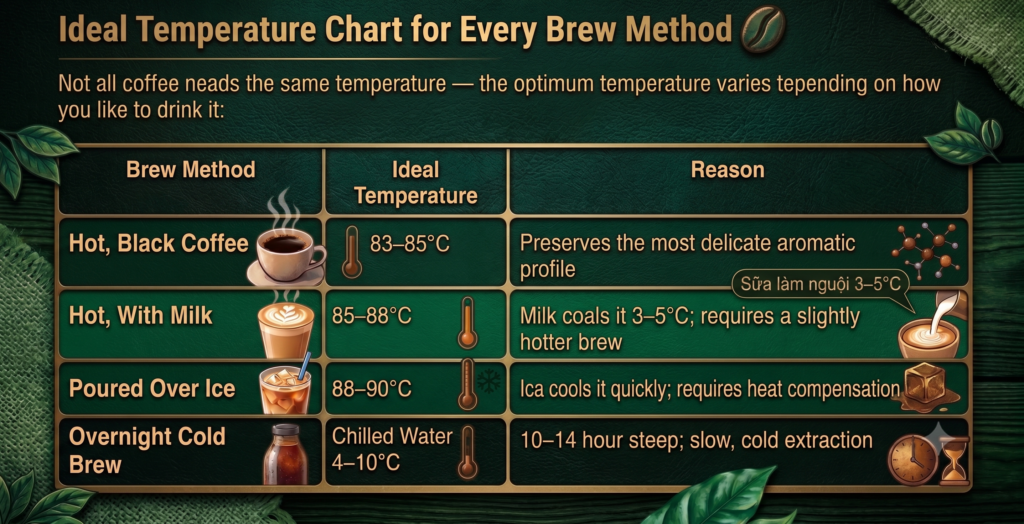
What’s the correct temperature for brewing freeze-dried coffee? The ideal temperature for hot, black coffee is 83–85°C. If brewing with milk, increase to 85–88°C to compensate for the temperature drop when milk is added.
Why shouldn’t I use boiling water to brew coffee? At 100°C, volatile aromatic compounds (like linalool and geraniol) escape into the air too quickly to dissolve into the water, while beneficial organic acids break down into harsh bitterness leaving the coffee smelling great as you brew it, but tasting flat and bitter when you drink it.
How can I gauge water temperature without a thermometer? Three ways: boil the water then wait 2–3 minutes, watch for small, steady bubbles at the bottom of the pot (before a full rolling boil), or rinse the cup with boiling water before pouring in your brewing water.
Does the ideal temperature change if I add milk or ice? Yes. For coffee with milk, brew at 85–88°C. For coffee you’ll pour over ice, brew at 88–90°C since both milk and ice significantly lower the temperature right after brewing.
Why should I rinse the cup before brewing? Because a cold cup absorbs heat from the hot water almost instantly, which can lower the brewing temperature by 3–8°C within the first few seconds enough to push the coffee out of its ideal temperature range.
Brew it right with K7 CAPHE today
The best flavor doesn’t come from good ingredients alone it also comes from brewing it the right way. K7 CAPHE freeze-dried coffee preserves the essence of Vietnamese Arabica from Cầu Đất and Khe Sanh, blended with Đắk Lắk Robusta. The rest is up to you: 83–85°C water, no sugar the first time, and an unhurried morning to really taste it.
Domestic customers: Order now via our website or e-commerce platform: Buy now — K7 CAPHE on Shopee
International customers: Please reach out to us directly: Contact K7 CAPHE
