




Imagine stepping outside right after a forest rain and taking a deep breath damp earth, tree roots, wet bark, all blending together. Now add a bar of bittersweet 85% dark chocolate and a faint hint of campfire smoke. You’ve just sketched out the flavor of Sumatra Mandheling the world’s most mysterious and distinctive Arabica, unlike anything you’ve tasted before.
(A quick note: K7 CAPHE does not use Sumatra Mandheling Arabica in its products. This article is a journey into one of the world’s most unique coffee regions so you can better understand why every land speaks its own flavor language, and why Vietnamese Arabica from Cầu Đất & Khe Sanh deserves to tell its own story in the same way.)
What is Sumatra Mandheling? A story from the heart of Sumatra
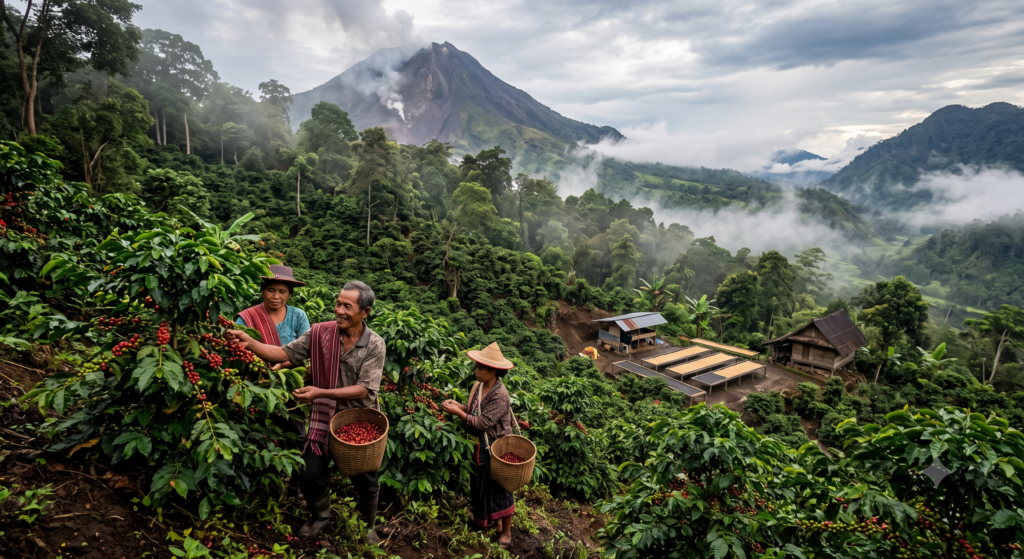
To understand Sumatra Mandheling, you first need to know that “Mandheling” isn’t the name of a geographic region it’s the name of an indigenous ethnic group in North Sumatra, Indonesia. The Batak Mandailing people (the original spelling) are the community tied to coffee farming on the slopes of the Bukit Barisan mountains since the Dutch first brought Arabica here for experimental planting in the 19th century.
The Bukit Barisan range runs the entire length of Sumatra like a massive spine, with its highest peak rising above 3,800 meters. Mandheling coffee is grown at 700–1,500 meters on these slopes not as high as Yirgacheffe or Cầu Đất, but compensated for by something no other land can replicate: a tropical forest soil ecosystem extraordinarily rich in organic humus, accumulated over thousands of years from the primary forest vegetation blanketing Bukit Barisan.
That very soil heavy with the scent of forest earth, rich in microorganisms, damp year-round is the source of the legendary “earthy notes” that Mandheling lovers never tire of describing.
Today, Sumatra Mandheling is one of Indonesia’s most widely exported coffees and sits on the “must-try” list of nearly every Q-grader in the world not because it’s the best coffee in a conventional sense, but because it’s the most distinctive, unmistakable coffee there is.
The secret few tell you: the Giling Basah process (wet-hulling)
This is the part most coffee articles skip but it’s the key to understanding why Sumatra Mandheling tastes unlike any other coffee in the world.
In most coffee-growing countries, after harvesting, beans are processed using one of two main methods: washed (skin removed, then dried) or natural (dried whole). Both share one thing in common: the beans are left to dry completely before the hard outer shell (called the parchment) is removed.
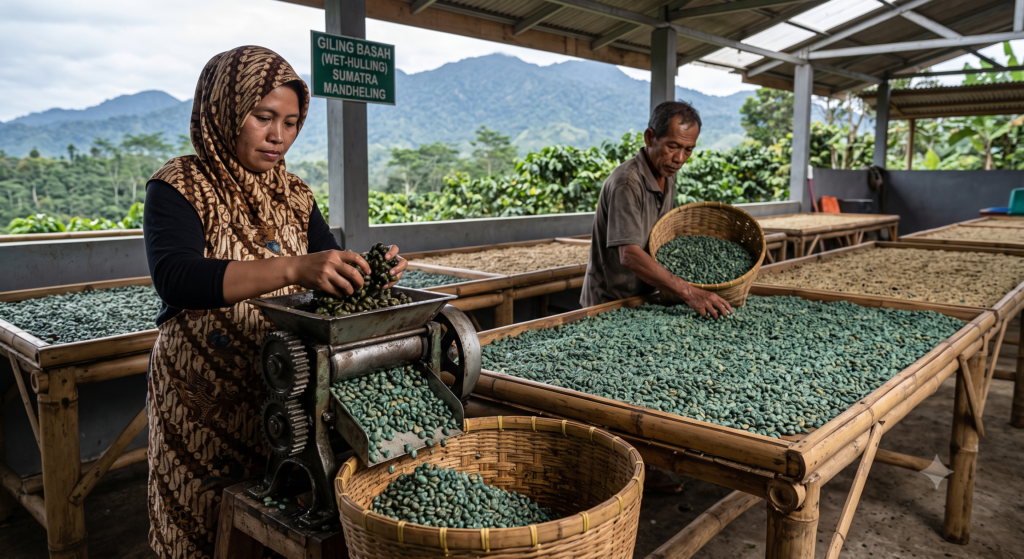
Indonesia does things differently. Sumatran farmers developed a process found nowhere else in the world: Giling Basah, or wet-hulling.
Here’s how it works: after harvesting and initial fermentation, the outer parchment is removed while the beans are still wet while moisture content is still at 30–50% (compared to the ideal 10–12% used in conventional methods). Those damp green beans are then set out in the sun to dry gradually.
It sounds simple but the impact on flavor runs remarkably deep.
When the parchment is removed while the bean is still moist, the internal cellular structure changes completely: the bean becomes softer, takes on a distinctive green color unlike ordinary green coffee, and most importantly oxidation and fermentation continue happening directly on the bean’s surface throughout the subsequent drying stage.
Four flavor traits that only Giling Basah can produce
The result of all that complexity is four flavor characteristics found in no other process:
- An extremely heavy, syrupy body — the heaviest of any Arabica, giving the sensation of drinking something with real physical substance
- Signature earthy notes — damp earth, tree roots, forest after rain — born from Giling Basah’s unique oxidation process
- Extremely low acidity — nearly imperceptible, ideal for those with sensitive stomachs
- Dark chocolate and herbal notes — rich, warm, and unmistakably mysterious
The flavor of Sumatra Mandheling: a morning in the rainforest
If Ethiopia is an early morning in a flower garden, and Colombia is an autumn afternoon in a bakery then Sumatra Mandheling is an evening by a campfire, deep in an old-growth forest, with a glass of red wine set beside a bar of dark chocolate.
Aroma when brewing: Damp earth after rain is the first and strongest note not mud or a musty smell, but petrichor, the scent of clean, rain-soaked soil, sensual and grounding in a very primal way. Following that comes bitter dark chocolate, cedar, and sometimes a hint of light tobacco and dried herbs.
Dominant flavor: A full, syrupy body every sip carries a distinctive weight and viscosity. Bittersweet dark chocolate dominates, joined by herbal notes reminiscent of licorice and occasionally a touch of cedar. No fruit notes, no floral notes, Mandheling is coffee of “earth and wood,” not “flowers and fruit.”
Body: Heavier and fuller than any other Arabica — the kind of body that dark-roast and strong-cappuccino fans will instantly recognize and love.
Acidity: Extremely low — nearly zero. This is a gift for anyone who loves bold coffee but whose stomach is often irritated by acidity.
Finish: Long and complex — light smoke, wood, sometimes a hint of pure cacao. The finish can last 2–3 minutes after drinking, revealing a new note each moment.
Q score: 83–87 points — enough to qualify as specialty, though Mandheling isn’t celebrated for elegance or subtlety. It’s recognized for its unique, irreplaceable character something no score can fully capture.
Sumatra Mandheling and freeze-dried coffee: challenge and opportunity
Turning Sumatra Mandheling into instant coffee is no small technical challenge and this is where the difference between freeze-drying and spray-drying shows most clearly.
The biggest challenge: Mandheling’s earthy notes the very soul of this coffee are extremely difficult to preserve. In traditional spray-drying, high heat breaks down the organic compounds responsible for that signature earthy aroma, turning them into unwanted harsh bitterness. The result: all character lost, leaving only crude bitterness and that all-too-familiar “cheap coffee” smell.
The opportunity with freeze-drying: At minus 40°C, earthy compounds including geosmin and methoxypyrazine, molecules noted for their role in that signature damp-earth aroma are frozen and preserved intact. Mandheling’s heavy, syrupy body is also retained far better than with any heat-based processing method, producing a fullness unlike anything found in ordinary instant coffee.
An important blending principle: Mandheling’s earthy notes can become “overwhelming” when used alone like eating an entire bar of 99% dark chocolate with nothing to balance it. When blended with a floral or lightly fruity Arabica, these two opposing flavor profiles create an interesting balance: earthy provides the foundation, floral adds a bright highlight much like pairing dark chocolate with a touch of flaky salt to make it pop.
Who should try Sumatra Mandheling? And who shouldn’t?
Sumatra Mandheling isn’t for everyone and that’s perfectly fine. That polarizing nature is part of its appeal.
You’ll love Mandheling if:
- You’re a fan of dark roast and bold espresso — Mandheling’s heavy body and chocolate notes will resonate perfectly with what you’re looking for, but with a flavor depth ordinary dark roast doesn’t have.
- You’re already familiar with Ethiopia and Colombia and want to experience an entirely new dimension of specialty coffee, Mandheling is the natural next step in your exploration.
- You often drink coffee with milk — Mandheling’s rich chocolate notes still come through even with a full pour of milk, unlike many lighter Arabicas that fade or lose their aroma.
- You have a sensitive stomach but still want bold coffee — Mandheling’s extremely low acidity makes it one of the gentlest options in the Arabica world.
You might not be ready for Mandheling if:
- You’re new to exploring specialty coffee and not yet used to complex flavors start with Colombia or Vietnamese Arabica first, then work your way toward Mandheling once your palate has adjusted to specialty coffee’s range.
- You prefer light, floral, and fruity coffee — Mandheling is the complete opposite world, and it’s more likely to confuse you than delight you.
From Sumatra to Vietnam: same philosophy, different land
K7 CAPHE doesn’t use Sumatra Mandheling Arabica but the lesson from Mandheling is very close to our own philosophy: every land speaks its own flavor language, and technology’s job is to preserve that language, not erase it.
Đắk Lắk Robusta in the K7 CAPHE blend doesn’t have Mandheling’s earthy notes but it has a full body, thick crema, and the distinctive strength of the Central Highlands’ red basalt soil. Arabica from Cầu Đất and Khe Sanh brings flavor depth and natural sweetness. Freeze-drying holds it all together, without letting heat erase any of it.
That’s how K7 CAPHE writes its own flavor story no need to copy Mandheling, no need to pretend to be Ethiopia or Colombia. Just Vietnam, done the right way.
Frequently asked questions
What is Sumatra Mandheling? Sumatra Mandheling is an Arabica coffee grown on the Bukit Barisan mountains in North Sumatra, Indonesia, named after the Batak Mandailing ethnic group. It’s one of the world’s most famous coffees for its distinctive earthy, chocolatey flavor, unlike any other growing region.
What is Giling Basah (wet-hulling)? Giling Basah is a processing method unique to Indonesia, in which the hard parchment shell is removed while the bean is still wet (30–50% moisture) rather than being left to dry fully as in conventional methods. This process is what creates Mandheling’s heavy body, low acidity, and signature earthy flavor.
Why does Mandheling coffee taste earthy? Its earthy notes form from a unique oxidation process that occurs on the bean’s surface during and after Giling Basah, combined with the humus-rich tropical forest soil of the Bukit Barisan mountains.
Who is Sumatra Mandheling suited for? It suits people who enjoy dark roast, bold espresso, coffee with milk, or those with stomachs sensitive to acidity. It’s less suited to specialty coffee beginners or people who prefer light, floral, fruity flavors.
What is the Q score of Sumatra Mandheling? Typically 83–87 points on the SCA’s 100-point scale enough to qualify as specialty coffee, though it’s valued mainly for its unique character rather than conventional refinement.
The coffee world is bigger than you think start with K7 CAPHE
From Yirgacheffe to Mandheling, from Colombia to Cầu Đất every land tells a different story. K7 CAPHE is the easiest, most convenient way to begin that journey of discovery high-quality Vietnamese Arabica, preserved note by note through freeze-drying technology, with no additives and no artificial flavoring.
Domestic customers: Order now via our website or e-commerce platform: Buy now — K7 CAPHE on Shopee
International customers: Please reach out to us directly: Contact K7 CAPHE
