




In 1855, Emperor Napoleon III ordered every Bordeaux château to be classified by quality for display at the Paris International Exhibition. The result: Château Pétrus a small 11.4-hectare plot sitting on a distinctive blue-clay hill in Pomerol was ranked at the very top. Today, a bottle of Château Pétrus can sell for $5,000–$10,000. The same Merlot grape, grown just a few kilometers away, sells for $50. The difference isn’t in the name, and it isn’t marketing. It lies in what the French call “terroir” the spirit of the land. And what’s happening in the specialty coffee world today is exactly that same terroir revolution few people just haven’t noticed yet.
What is terroir? And why is this 500-year-old concept reshaping the coffee industry?
The French word “terroir” comes from “terre” land. But terroir isn’t simply soil. According to the Institut National de l’Origine et de la Qualité (INAO) France’s geographical-indication authority terroir is “a limited geographic space in which a human community builds, over time, collective production knowledge based on a system of interactions between a physical and biological environment and a set of human factors.”
In simpler terms: terroir is the sum of everything that makes one plot of land different from the one next to it soil, water, microclimate, altitude, sunlight, soil microorganisms, and the hands of the people who have tended that land across generations.
The wine world has used this concept for 500 years to build a classification system detailed enough that each individual vineyard can be identified separately Appellation d’Origine Contrôlée (AOC) in France, Denominazione di Origine Controllata (DOC) in Italy. The result: a knowledgeable wine drinker can take one sip and guess “this is a 2018 Pinot Noir from Burgundy, likely from Gevrey-Chambertin” from taste alone.
The question is: can the same thing happen with coffee? The answer, increasingly clear, is: yes and it’s happening right now. Since the 1990s, the global specialty coffee community has begun applying terroir thinking seriously. Cup of Excellence the world’s most prestigious specialty-coffee competition scores and documents the detailed terroir of every winning lot. The SCA (Specialty Coffee Association) built the Q Score system with 10 evaluation criteria, many of which directly reflect a growing region’s terroir. Q-Graders are trained to “read” terroir through flavor much like a sommelier reads terroir through wine.
The four pillars of coffee terroir: what shapes flavor before the beans are even picked
Pillar 1 — Soil: the author of the mineral signature
No terroir factor has a deeper or more lasting impact than soil the material a coffee tree roots into for the entire 20–30 years of its life.
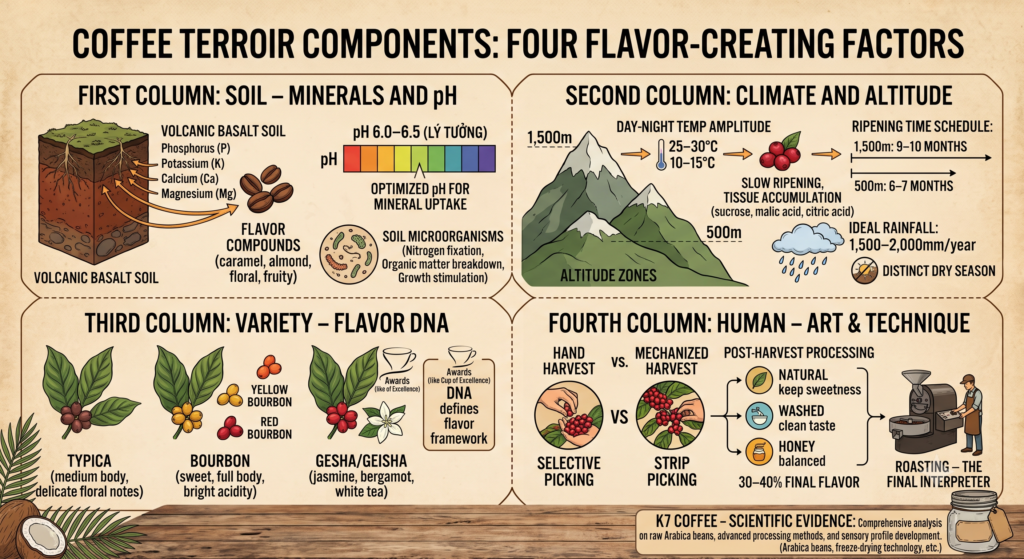
Volcanic basalt soil is the “holy ground” of high-quality Arabica. Basalt soil forms from volcanic lava over millions of years rich in minerals, especially phosphorus (P), potassium (K), calcium (Ca), and magnesium (Mg), in the ratios and chemical forms coffee roots absorb most easily. As these minerals enter the coffee bean, they take part in hundreds of biochemical reactions that build flavor compounds caramel, almond, floral, fruity notes. That’s why Cầu Đất (Lâm Đồng), Khe Sanh (Quảng Trị), and Đắk Lắk all sitting on Vietnam’s red basalt soil produce coffee with fuller body, more complex flavor, and higher Q Scores than coffee grown on alluvial soil.
Soil pH is the key to mineral absorption: Arabica trees absorb minerals best when soil pH sits between 6.0 and 6.5 slightly acidic. At this pH, mineral ions dissolve in the soil water and can enter roots through osmosis. When pH is too high (alkaline soil) or too low (strongly acidic soil), many minerals get “locked” into insoluble forms the tree can’t absorb them even though they’re present in the soil. Vietnam’s red basalt soil naturally sits around pH 5.5–6.5 nearly ideal for Arabica without much adjustment.
Soil microorganisms are the quietest terroir factor of all a point modern soil science is still exploring, with much left to fully understand. A single gram of tropical forest soil can contain billions of bacteria, fungi, and protozoa forming a complex microscopic ecosystem. These microorganisms break down organic matter, fix nitrogen, synthesize growth-stimulating compounds, and influence how well roots absorb minerals. The same variety grown on two plots with different microbial communities can produce different flavors one reason terroir can never be replicated, even with the same variety, temperature, and rainfall.
Pillar 2 — Climate and altitude: the secret of slow ripening
If soil is the “raw material” that determines what a coffee tree can access, climate is the “kitchen” that determines how those raw materials get transformed into flavor inside the cherry.
Day-night temperature swing is the single most important climate factor in coffee terroir, and something few outside the industry know about. When daytime temperatures are high (25–30°C), the plant photosynthesizes intensely, producing lots of sugar. When nighttime temperatures are low (10–15°C), the fruit’s respiration slows down sugar and organic compounds aren’t “burned off” overnight but instead accumulate in the bean. The bigger the day-night swing, the slower the fruit ripens, the more it accumulates, and the more complex and refined the flavor. Cầu Đất, at 1,500m elevation, regularly sees a day-night swing of 15–20°C nearly matching the world’s most famous coffee regions like Yirgacheffe (Ethiopia) or Huila (Colombia). That’s no coincidence it’s why Cầu Đất Arabica reaches Q Scores of 83–86.
Every additional 100m of elevation adds roughly 2 more weeks of “maturing”: it’s a rule of thumb in coffee agronomy that every 100m increase in elevation drops the average temperature by about 0.6°C, and requires the coffee cherry roughly 2 more weeks to ripen. Coffee grown at 1,500m needs about 9–10 months to fully ripen from flowering, while coffee at 500m needs only 6–7 months. Those extra 3 months of ripening are 3 months of accumulating more sucrose, malic acid, citric acid, and hundreds of flavor compounds all imprinted into the bean in a way no processing method can replicate.
Rainfall and its distribution: 1,500–2,000mm/year is the ideal range for Arabica enough for roots to access water continuously without waterlogging and rotting. Just as important is the distribution: a distinct 2–3-month dry season before harvest mildly “stresses” the plant, encouraging the fruit to direct energy toward the bean rather than the skin increasing bean density and flavor.
Pillar 3 — Variety: the DNA of flavor
The variety (cultivar) is the genetic “blueprint” that sets the basic flavor framework terroir will then “fill in.”
| Variety | Characteristics |
|---|---|
| Typica | The oldest variety, carrying DNA directly traced to 17th-century Yemen. Medium body, delicate floral aroma, mild acidity. This is the variety the French brought to Cầu Đất in the 1890s. |
| Bourbon | A natural mutation of Typica, discovered on Réunion Island (formerly named Bourbon). Sweeter than Typica, fuller body, brighter acidity. Two well-known sub-varieties: Yellow Bourbon (yellow-ripening cherries, less common) and Red Bourbon (red-ripening cherries, more common). |
| Gesha/Geisha | Originates from the village of Gesha, Ethiopia. Uncommon due to low yield and demanding growing conditions but its flavor is described as “unlike anything else in the world”: intense jasmine, bergamot, white tea. A single kilogram of Gesha can fetch $1,000 at Cup of Excellence auctions. |
Pillar 4 — People: the craftspeople who finish the flavor
This is the only conscious terroir factor and the one that creates the biggest difference within the very same plot of land.
Selective picking vs. mechanical harvesting: hand-picking each ripe red cherry (selective picking) versus stripping entire branches regardless of ripeness (strip picking) results in completely different input quality. A single unripe cherry in a roasting batch can create an unpleasant sharp sourness that affects the whole batch. Selective picking costs 3–4 times more in labor but is a prerequisite for specialty coffee.
Post-harvest processing 30–40% of the final flavor: natural, washed, or honey processing isn’t just a “technique” it’s the farmer’s art and philosophy. Natural processing retains more sweetness from the fruit pulp. Washed processing produces the cleanest, most distinct expression of terroir. Honey processing balances the two. The same farm, the same harvest, but two farmers processing it differently will produce two completely different cups.
Roasting, the final interpreter: the roaster doesn’t create flavor they interpret the latent flavor in the green bean into a language drinkers can perceive. A skilled roaster knows exactly when to stop to preserve the floral notes of an Ethiopian Yirgacheffe, and when to push a bit further to bring out the chocolate notes of a Guatemalan lot. A bad roast can completely ruin an excellent lot. A great roast can turn a good lot into an exceptional one.
The million-dollar question: does freeze-drying really preserve the “spirit of place”?
This is the question the entire article has been building toward and the answer depends on how you define “spirit of place.”
In coffee, “spirit of place” means the flavor compounds specific to a growing region: linalool and geraniol in Yirgacheffe, the sharp malic acid of Kenya, the caramel and almond of Cầu Đất Arabica, the warm chocolate of Khe Sanh. These compounds are each region’s “molecular signature” formed over months of interaction between soil minerals, climate, variety, and the farmer’s hands.
| Method | What happens to terroir flavor |
|---|---|
| Dark roasting | High heat transforms hundreds of flavor compounds some destroyed, some newly created (Maillard reaction, caramelization). The flavor generated by roasting gradually overwhelms and masks the flavor generated by terroir. The darker the roast, the fainter the terroir signature which is why dark-roasted Ethiopian coffee and dark-roasted Brazilian coffee can become hard to tell apart, even though the original green beans were completely different. |
| Industrial spray-drying | Temperatures of 150–200°C strip away most of the volatile compounds that survived roasting the most fleeting, most delicate compounds, which are also the ones that carry the clearest terroir signature. |
| Freeze-drying | At -40°C, no further thermal reactions occur. No new Maillard reaction. No additional caramelization. No volatile compounds get burned off. The coffee is “frozen” at exactly its post-roast chemical state and as the water sublimates in a vacuum chamber, the resulting crystal structure preserves the flavor compounds like a time capsule. |
When you dissolve K7 CAPHE freeze-dried coffee in hot water, you’re not just mixing an industrial powder you’re “unlocking” a cup of coffee that was already brewed and had its flavor completely frozen in time. The caramel of Cầu Đất’s red basalt soil. The warm chocolate of Khe Sanh’s humus-rich soil. The bold crema of Đắk Lắk Robusta. All of it is there, waiting for the moment you pour the water in.
Sensory evidence: people working in the specialty coffee industry, when tasting high-quality freeze-dried coffee against the exact same lot spray-dried, often describe it this way: “It feels like drinking freshly brewed coffee the aroma bursts out immediately, with depth, with layers. Not flat like regular instant coffee.” This isn’t a coincidence. It’s physics and chemistry behaving exactly as we understand heat interacts with flavor compounds.
Vietnam’s terroir, a story not yet fully told
Vietnam is the world’s second-largest coffee exporter but most of that export is raw Robusta, used as raw material for global industrial instant coffee. Vietnamese coffee’s terroir story has rarely been told outside the country not because there’s nothing to tell, but because the industry has grown far too used to selling volume rather than selling a story.
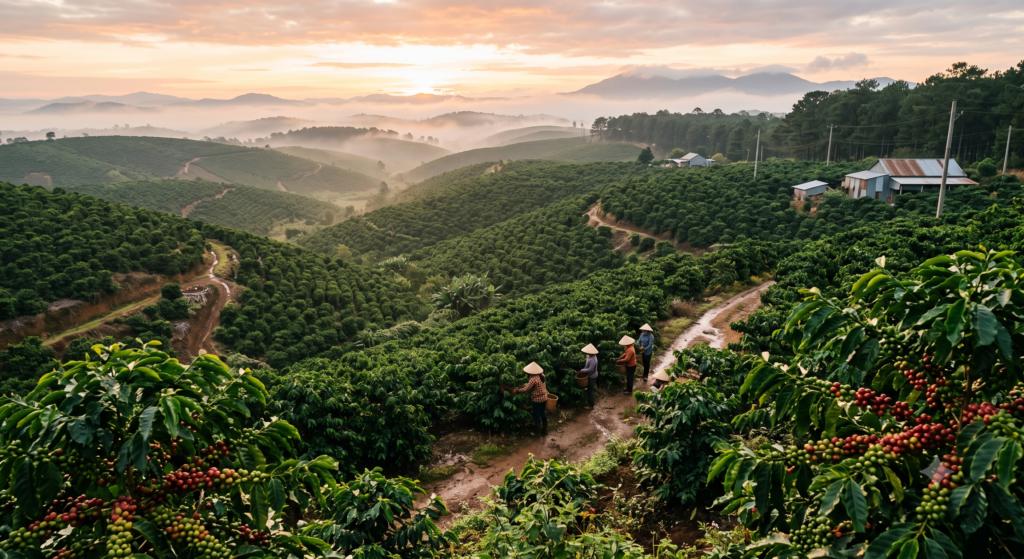
But looking at Vietnam’s geological and climate map, it’s clear the country has everything needed to produce world-class specialty coffee across several distinct regions:
| Region | Terroir characteristics |
|---|---|
| Cầu Đất (1,500m, red basalt soil, year-round fog) | A terroir closer to Colombia’s Huila than any other region in Southeast Asia potential for floral, caramel Arabica with balanced acidity. |
| Khe Sanh (700m, Trường Sơn humus soil, distinctive central-Vietnam climate) | A unique terroir found nowhere else — full-bodied Arabica, warm chocolate, low acidity. A “mysterious terroir” still waiting to be discovered. |
| Đắk Lắk (500–600m, Central Highlands basalt soil, tropical highland climate) | Vietnam’s finest Robusta not “cheap” Robusta, but Robusta with genuine terroir and an unmistakable, distinctive body. |
Three regions, three different terroir stories all converging into every single stick of K7 CAPHE freeze-dried coffee.
Frequently asked questions about Coffee Terroir
What is terroir in coffee? Terroir is the sum of soil, water, microclimate, altitude, sunlight, soil microorganisms, and human hands all the factors that make coffee grown on one plot of land taste different from coffee grown on the plot next to it. The concept has been used by the wine world for 500 years and has been seriously applied by the specialty coffee community since the 1990s.
How does volcanic soil affect coffee flavor? Volcanic basalt soil is rich in phosphorus, potassium, calcium, and magnesium in chemical forms that are easy to absorb these minerals take part in hundreds of biochemical reactions that create caramel, almond, floral, and fruity notes in the bean. This is why coffee grown on red basalt soil like Cầu Đất, Khe Sanh, and Đắk Lắk has a fuller body and higher Q Scores than coffee grown on alluvial soil.
Why does the day-night temperature swing matter for coffee quality? The bigger the temperature swing, the more slowly coffee cherries ripen, and the more sugar and organic compounds accumulate producing more complex, refined flavor. Cầu Đất has a day-night swing of 15–20°C, close to world-famous coffee regions like Yirgacheffe or Huila.
Why does dark roasting fade the terroir signature? High heat during roasting transforms hundreds of flavor compounds through the Maillard reaction and caramelization the flavor created by roasting gradually overwhelms the region’s distinctive flavor. The darker the roast, the fainter the terroir signature, making coffee from different regions harder to tell apart.
How does freeze-drying differ from spray-drying in preserving terroir flavor? Spray-drying at 150–200°C strips away most of the most volatile flavor compounds exactly the ones that carry the clearest terroir signature. Freeze-drying at -40°C creates no additional thermal reactions, preserving the flavor structure as it existed at the moment the coffee was brewed.

How do K7 CAPHE’s three growing regions differ in terroir? Cầu Đất (1,500m, red basalt soil) produces floral, caramel Arabica with balanced acidity, close to Colombia’s Huila terroir. Khe Sanh (700m, Trường Sơn humus soil) produces full-bodied Arabica with warm chocolate notes and low acidity. Đắk Lắk (500–600m, Central Highlands basalt soil) produces Robusta with a distinct terroir and a characteristic body.
Here’s a way worth thinking about K7 CAPHE after reading all of this: not just “convenient instant coffee” though it truly is convenient and not just “additive-free instant coffee” though that’s true too. It’s a flavor postcard sent from the red basalt soil of Cầu Đất, from the mountain forests of Khe Sanh, from the highlands of Đắk Lắk sealed with freeze-drying technology so the flavor doesn’t get lost along the way, and “opened” every time you dissolve it in hot water, anywhere in the world.
Some people can drink a Château Pétrus and feel the “spirit of place” of a blue-clay hill in Pomerol in every sip. Some people can drink a washed Yirgacheffe and “hear” Ethiopia’s coffee forests through its jasmine aroma. And now, people can dissolve a stick of K7 CAPHE and receive if they know how to listen the story of these remarkable Vietnamese lands. The caramel and almond of Cầu Đất’s mist. The warm chocolate of Khe Sanh’s forest soil. The enduring strength of Đắk Lắk’s basalt. Terroir doesn’t need words to explain itself it speaks through flavor, if you’re willing to listen.
From the science of taste to geological terroir. From biohacking to 600 years of Qahwa history. From freeze-drying technology to the spirit of each growing region. All of it leads to one conclusion: drinking coffee can be a genuine journey of discovery if you start from the right place. K7 CAPHE freeze-dried coffee is that starting point. Arabica from Cầu Đất and Khe Sanh. Robusta from Đắk Lắk. Freeze-drying technology that preserves the “spirit of place.” No additives, no flavorings, nothing hidden just coffee, and the story of the land that made it.
Domestic customers: Buy now on our website or on e-commerce platforms: Buy now — Shopee K7 CAPHE
International customers: Please contact us for assistance: Contact K7 CAPHE
