




You love coffee. But your stomach doesn’t love you back for it. That’s the contradiction millions of people in Vietnam live with every day a cup that wakes you up, followed an hour later by a dull ache, heartburn, and a burning feeling. Most of them assume the problem is coffee itself. The truth is: the problem isn’t coffee. The problem is HOW it was processed and what high heat did to the coffee bean’s chemistry before it ever reached your cup.
The journey of acid in your cup: from bean to stomach
To understand why coffees differ so much in how much they irritate the stomach, you need to trace the acid’s journey through the entire process from the moment the plant fruits to the last sip you take.
In fresh, unroasted coffee beans, there are about 30–40 different organic acids, making up roughly 6–8% of the dry weight. Most of that is chlorogenic acid (CGA) accounting for 6–10% of a green bean’s weight. This is an antioxidant acid, beneficial to health, and doesn’t cause meaningful stomach irritation at normal doses. There’s also citric acid, malic acid, and acetic acid all mild, natural organic acids, not the main culprits behind stomach pain.
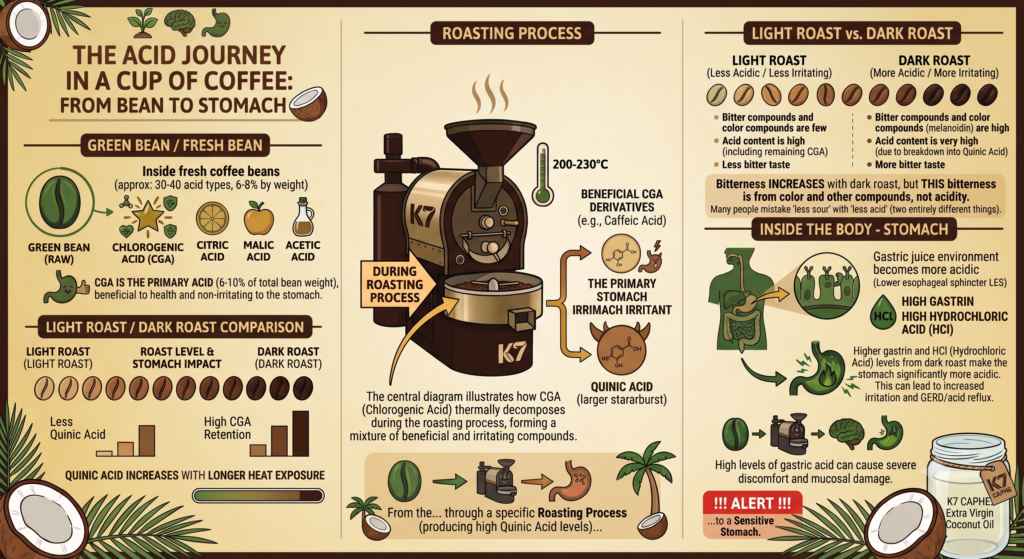
What happens during roasting? This is where things start turning unfavorable for your stomach and few people know about it. During roasting at 200–230°C, chlorogenic acid (CGA) breaks down thermally, decomposing into various compounds, including quinic acid and caffeic acid. Quinic acid is what researchers have identified as coffee’s real stomach saboteur: it stimulates stomach-lining cells to secrete more gastrin the hormone that regulates hydrochloric acid (HCl) production in the stomach. More gastrin → more HCl → a more acidic stomach environment → lining irritation, and acid pushed back up through the lower esophageal sphincter (LES).
The darker the roast, the more quinic acid: this runs counter to what most people assume. Many people with sensitive stomachs choose dark-roast coffee, thinking “more bitter = less sour = less irritating.” But chemically, dark-roast coffee actually contains more quinic acid than light roast, because longer heat exposure means more CGA breaks down into quinic acid. Bitterness increases with darker roasting but that bitterness comes from different compounds (melanoidins, phenylindanes), not from quinic acid. You’re confusing “less sour-tasting” with “less acid” two completely different things.
Caffeine and the lower esophageal sphincter: the second accomplice
Alongside the acid issue, caffeine also plays a role in the reflux story but through a completely different mechanism that few people notice.
The LES (lower esophageal sphincter) is a muscular “valve” located where the esophagus meets the stomach. Its job is to open when you swallow food, then close tightly to prevent stomach acid from rising back up. When the LES works normally, you never feel reflux no matter how acidic your stomach is. Caffeine reduces the LES’s muscle tone it “relaxes” this sphincter, so the valve doesn’t close as tightly as it should. The result: stomach acid can rise more easily, especially if you drink coffee on an empty stomach or lie down right after.
| Coffee type | Caffeine content | Degree of LES relaxation |
|---|---|---|
| Arabica | About 1.2% | Lower |
| Robusta | About 2.7% (more than double Arabica) | Significantly higher |
For people with sensitive stomachs, this isn’t a small difference it’s the difference between being able to drink coffee comfortably and not. It’s no coincidence that most studies on “coffee and GERD” (gastroesophageal reflux disease) find that patients can drink a moderate amount of mild coffee without worsening symptoms but almost none of them study the difference between Arabica and Robusta specifically, since research tends to focus on coffee in general, without distinguishing between varieties.
The secret of freeze-drying: why the acid profile is completely different
This is the part most coffee drinkers have never heard and it’s the most specific scientific reason high-quality freeze-dried coffee is gentler on the stomach than regular roast-and-ground coffee or spray-dried instant coffee.
A quick recap of how freeze-drying works: brewed coffee is frozen down to -40°C, then the water is sublimated in a vacuum chamber no high heat is involved in turning it into powder. In traditional spray-drying, done at 150–200°C, some thermal-decomposition reactions continue during the powder-forming stage, generating additional quinic acid and other harsh acidic compounds. Freeze-drying involves no heat, so the acid profile of freeze-dried coffee powder stays much closer to freshly brewed coffee than spray-dried powder made from the same beans.
The actual pH numbers: several independent studies measuring the pH of different coffee formats produced some interesting results:
| Coffee type | pH |
|---|---|
| Regular hot-brewed coffee (pour-over, espresso) | 4.5–5.5 |
| Spray-dried instant coffee | 4.8–5.3 (comparable or slightly lower) |
| Cold brew from good-quality coffee | 5.8–6.5 — noticeably less acidic |
| Cold brew from high-quality freeze-dried coffee | 6.0–6.8 — closest to neutral |
Remember that pH is a logarithmic scale: pH 5.5 is 10 times more acidic than pH 6.5, not 1.5 times as many people assume. The difference between regular hot-brewed coffee and cold brew made from freeze-dried coffee isn’t small, it’s an entire order of magnitude on the acid scale.
Why is cold brew the least acidic? With cold extraction (cold water at 4–10°C over 8–12 hours), thermal decomposition doesn’t occur no new quinic acid is formed. The natural enzymes in coffee still act at cold temperatures, but much more slowly, producing a completely different acid profile than hot extraction. This is why cold brew is well known as a good option for sensitive stomachs and when you use freeze-dried coffee as the base for cold brew, you’re stacking two advantages: a lower-acid starting material plus the lowest-acid extraction method.
Gastrin, HCl, and the real mechanism behind stomach pain after coffee
Many people think coffee causes stomach pain because it’s “sour” but the actual mechanism is more complex and far more interesting.
| Step | What happens |
|---|---|
| 1 | Quinic acid and other compounds in coffee stimulate G cells in the stomach’s antrum to release gastrin into the bloodstream. |
| 2 | Gastrin travels through the blood to parietal cells in the stomach’s body, stimulating them to pump H⁺ ions into the stomach cavity, forming HCl. |
| 3 | HCl concentration rises, and stomach pH drops (becomes more acidic). In healthy people, the protective mucus layer lining the stomach is thick enough to withstand this. But in people with a thinner mucus layer, existing gastritis, or an empty stomach (no food to act as a “buffer”) acid comes into direct contact with the lining, causing pain and a burning sensation. |
| 4 — Reflux | At the same time, caffeine relaxes the LES. Increased stomach pressure (from post-meal contractions) plus a loosely closed LES equals acid rising into the esophagus. The esophagus lacks the protective mucus layer the stomach has, causing a burning throat and discomfort behind the breastbone. |
A dangerous loop: many people drink coffee to feel alert → their stomach gets uncomfortable → they drink more to try to stay alert → their stomach gets worse. Breaking that loop doesn’t mean giving up coffee, it means choosing a less irritating type of coffee and drinking it the right way.
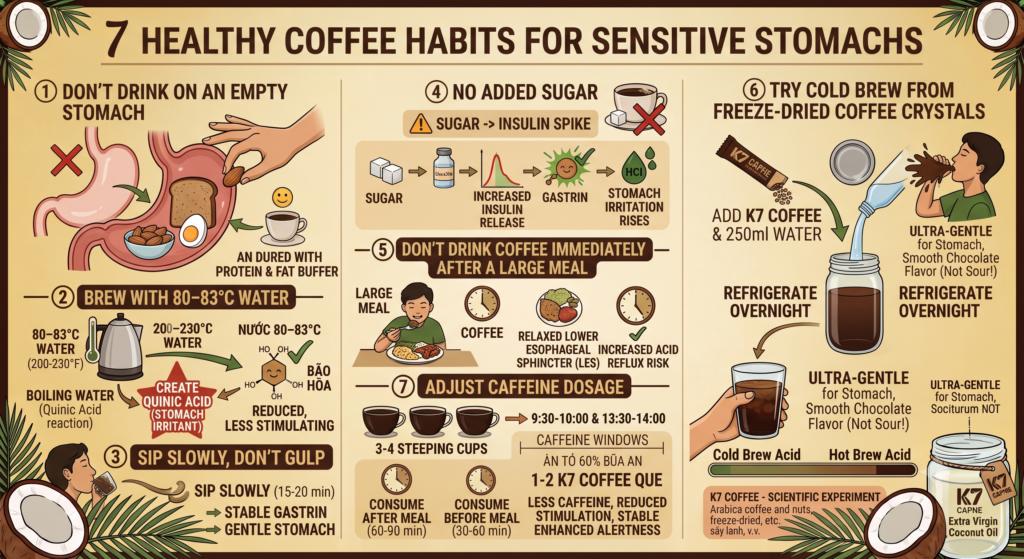
7 coffee-drinking habits for sensitive stomachs
| Habit | Why it works |
|---|---|
| 1. Don’t drink on a completely empty stomach | Food, especially protein and fat, slows gastric emptying and creates a “buffer zone” that reduces acid contact with the stomach lining. Eating something small even a few almonds or a slice of whole-grain bread before coffee makes a meaningful difference. |
| 2. Brew with 80–83°C water instead of boiling | High brewing temperatures continue to drive thermal-decomposition reactions that generate more quinic acid in the first few seconds water meets the coffee. At 83°C, this reaction barely occurs, while caffeine is still fully extracted. |
| 3. Drink slowly, not all at once | Drinking a large amount quickly creates a bigger, sudden gastrin “burst” compared to sipping small amounts over 15–20 minutes. Same amount of coffee, but spreading the stimulus over time lets the stomach respond more gently. |
| 4. Skip the sugar | Sugar stimulates insulin release, and insulin in turn stimulates gastrin release through an indirect pathway. Adding sugar to coffee doesn’t just cause a sugar crash it also amplifies stomach stimulation compared to drinking it black. |
| 5. Don’t drink it right after a large meal | The stomach is contracting hard to digest food, plus caffeine relaxing the LES, creates the highest chance for acid reflux. Ideally, drink coffee 30–60 minutes before a meal, or at least 60–90 minutes after, once digestion has settled. |
| 6. Try cold brew made from freeze-dried coffee | This is the lowest-acid brewing method you can make at home without any special equipment. One packet of K7 CAPHE + 250ml filtered water, refrigerated overnight, produces an exceptionally gentle cold brew, with a smooth chocolate flavor instead of the sourness of hot-brewed coffee. |
| 7. Manage your caffeine dose — less, but at the right time | Instead of drinking 3–4 cups of strong coffee a day to stay alert, try switching to 1–2 sticks of K7 CAPHE (lower caffeine, since it’s an Arabica blend, not pure Robusta) during the right “caffeine window” (9:30–10:00 AM and 1:30–2:00 PM). Less caffeine at the right time means less stomach irritation while still staying effective. |
Why is K7 CAPHE specifically a better fit for sensitive stomachs?
This isn’t a medical claim, it’s an analysis based on everything explained above:
- Arabica from Cầu Đất and Khe Sanh: contains 55% less caffeine than pure Robusta, meaning less LES relaxation and less gastrin stimulation through the caffeine pathway.
- Blended with Đắk Lắk Robusta, but not 100% Robusta: a reasonable blend between bold flavor and moderate caffeine, giving sensitive drinkers a balance instead of forcing a choice between “tasty but painful” and “gentle but bland.”
- Freeze-dried without heat: the powder’s acid profile stays close to freshly brewed coffee, without the extra quinic acid generated during processing the way spray-drying produces.
- No additives, no preservatives: some preservatives and additives in regular instant coffee can irritate the stomach lining in sensitive people. K7 CAPHE is pure coffee: nothing extra to worry about.
- 2g per stick, easy dose control: you can start with 1 stick brewed in 200ml of water (weaker than usual) and adjust gradually based on how your stomach handles it, instead of being “locked in” to a fixed strength like pre-made coffee drinks.
Frequently asked questions about coffee and acid reflux
Does coffee actually cause acid reflux, or is it about how it’s brewed? Mostly the latter. Chlorogenic acid in fresh coffee beans doesn’t cause meaningful irritation on its own but roasting at 200–230°C breaks CGA down into quinic acid, which stimulates gastrin and HCl production in the stomach. At the same time, caffeine relaxes the lower esophageal sphincter (LES), creating conditions for acid reflux.
Is dark-roast coffee less irritating to the stomach than light roast? The opposite is true. The darker the roast, the longer the heat exposure, and the more CGA breaks down into quinic acid. The increased bitterness in dark roast comes from other compounds (melanoidins, phenylindanes) and has nothing to do with the acid level that irritates the stomach.
Which causes less reflux, Arabica or Robusta? Arabica causes less reflux because it contains about 1.2% caffeine, compared to Robusta’s roughly 2.7% more than double. The more caffeine, the more the LES relaxes, and the more easily stomach acid can rise into the esophagus.
When’s the best time to drink coffee to reduce reflux risk? Avoid drinking on a completely empty stomach, and avoid drinking right after a large meal ideally 30–60 minutes before a meal, or at least 60–90 minutes after. Drink it slowly in small sips over 15–20 minutes rather than all at once.
Should people with GERD give up coffee entirely? Not necessarily. Most research on coffee and GERD shows patients can still drink a moderate amount of mild coffee without worsening symptoms. The issue usually lies more in the type of coffee, how it’s brewed, and when it’s drunk, rather than coffee-drinking itself.
The issue was never coffee itself it’s which coffee, how it’s brewed, when you drink it, and how much. Get these right, and you can enjoy coffee every day with a completely calm stomach. K7 CAPHE freeze-dried coffee, Vietnamese Arabica (Cầu Đất & Khe Sanh) blended with Đắk Lắk Robusta. No additives, freeze-dried without heat, brewed gently with 83°C water, a solution for coffee lovers who need to be gentler on their stomach.
Domestic customers: Buy now on our website or on e-commerce platforms: Buy now — Shopee K7 CAPHE
International customers: Please contact us for assistance: Contact K7 CAPHE
