




Right now, in your kitchen, there’s something Western biohackers happily pay for in supplement-pill form but in Vietnam, it’s sitting in your ordinary spice jar, costing a few thousand đồng a bag. A tiny pinch of black pepper fewer than 5 peppercorns but when added to your morning coffee, it quietly amplifies nearly everything in it: caffeine’s effects last longer, more chlorogenic acid gets absorbed, more polyphenols make it into your bloodstream. This might be the cheapest, most overlooked “supplement” in the world of health optimization.
What is piperine? Why does such a tiny compound have such outsized power?
Black pepper’s signature spicy bite comes from piperine an alkaloid that makes up about 5–9% of a dried peppercorn’s weight. Unlike capsaicin in chili peppers, which creates an intense burning sensation, piperine produces a warmer, slower, more pleasant kind of heat the kind people describe as “warming you from the inside.”
But piperine doesn’t just add spice. It’s also one of the most powerful natural “pharmacokinetic modifiers” known meaning it changes how the body processes and absorbs other substances.
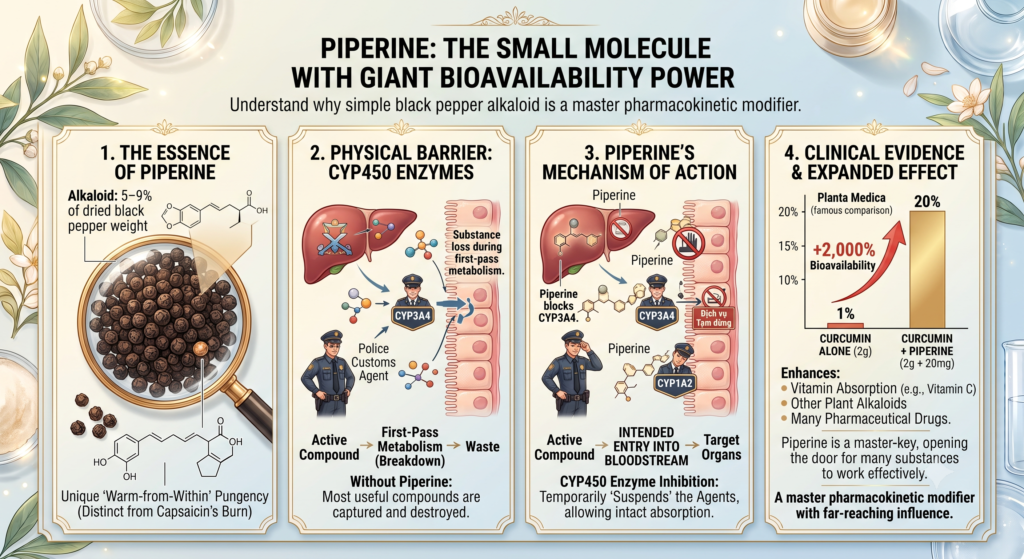
The main mechanism: piperine inhibits cytochrome P450 (CYP450) enzymes specifically CYP3A4 and CYP1A2 in the gut wall and liver. These are the enzymes responsible for breaking down and clearing out a huge range of chemical compounds before they reach the bloodstream, a process called “first-pass metabolism.”
Put simply: think of CYP450 as extremely strict “border-checkpoint officers” they intercept and destroy a large portion of nutrients and active compounds before they can reach the bloodstream and travel to their target organs. Piperine “temporarily suspends” those officers, letting more of an active compound cross through into circulation intact.
The most famous piece of evidence: a landmark study in Planta Medica (1998) found that adding just 20mg of piperine to 2g of curcumin boosted curcumin’s bioavailability by 2,000% from about 1% to nearly 20%. This is why anyone serious about turmeric knows black pepper has to come with it. But curcumin isn’t the only thing piperine helps with and this part is less widely known.
How does piperine affect what’s already in your coffee?
When you add black pepper to a high-quality freeze-dried coffee like K7 CAPHE, piperine doesn’t just sit there as a garnish it actively affects the bioavailability of three of the most important components in your cup:
| Component | Piperine’s effect |
|---|---|
| Caffeine | Caffeine is mainly metabolized by the CYP1A2 enzyme in the liver the same enzyme piperine inhibits. When CYP1A2 slows down, caffeine stays in the bloodstream longer. The result: the same amount of caffeine from one stick of K7 CAPHE, but the alertness effect lasts 30–60 minutes longer than drinking it without pepper letting you get a longer-lasting effect from less caffeine. |
| Chlorogenic acid | CGA is coffee’s most important polyphenol, responsible for much of the health benefit linked to regular coffee drinking. CGA is also partially metabolized by gut enzymes before absorption piperine slows this process, letting more CGA reach the intestinal lining intact. Some herbal studies suggest piperine can improve overall polyphenol bioavailability by 20–40%. |
| Overall antioxidant content | Black pepper isn’t just a passive “amplifier” it’s also a meaningful antioxidant source in its own right. On the ORAC scale, black pepper measures around 27,618 units/100g lower than cinnamon (267,536) but still higher than many common fruits and vegetables. |
Why is this the cheapest, most overlooked “upgrade” out there?
This is an interesting question and the answer has a lot to do with how the global pharmaceutical and supplement industry actually works.
- No patent, no incentive for large-scale research: piperine is a natural compound, and no one can patent it. No patent means no company has an incentive to spend millions of dollars on large-scale clinical trials to prove it works because no matter how good the results, any competitor could sell black pepper without infringing anything. The result: most of the evidence on piperine comes from smaller studies and in-vitro research, not the large clinical trials that back patented drugs.
- Too cheap to be “worth” marketing: a 100g bag of whole black peppercorns at a Vietnamese supermarket costs around 20,000–40,000 VND, enough for months of use. There’s not enough margin to fund ads, hire influencers, or run content marketing which is why you’ll find thousands of “top 10 supplements” videos on YouTube, but almost none mentioning black pepper, even though, by cost-to-benefit, it may be one of the most sensible things you can add to your morning routine.
- Biohackers know but don’t say it loudly: in serious biohacking circles, black pepper and piperine are foundational knowledge, mentioned by several well-known figures as a “force multiplier” that amplifies the effect of whatever else you’re taking. But since there’s no specific product to sell, this information rarely spreads to the mainstream.
The “Bioavailability Coffee” recipe — try it tomorrow morning
This is the simplest recipe in this spice series nothing extra to buy, no special equipment needed. What you need has been sitting in your kitchen all along.
Ingredients
| Ingredient | Amount |
|---|---|
| K7 CAPHE freeze-dried coffee | 1 stick |
| Water at 83°C | 150ml |
| Whole black peppercorns (coarsely ground right before use) | 3–5 peppercorns |
| Ceylon cinnamon (optional upgrade — adds an anti-inflammatory layer from cinnamaldehyde) | 1/4 teaspoon |
| Ground black turmeric (optional further upgrade — a three-way synergy of piperine + curcumin + caffeine) | 1/4 teaspoon |
Method
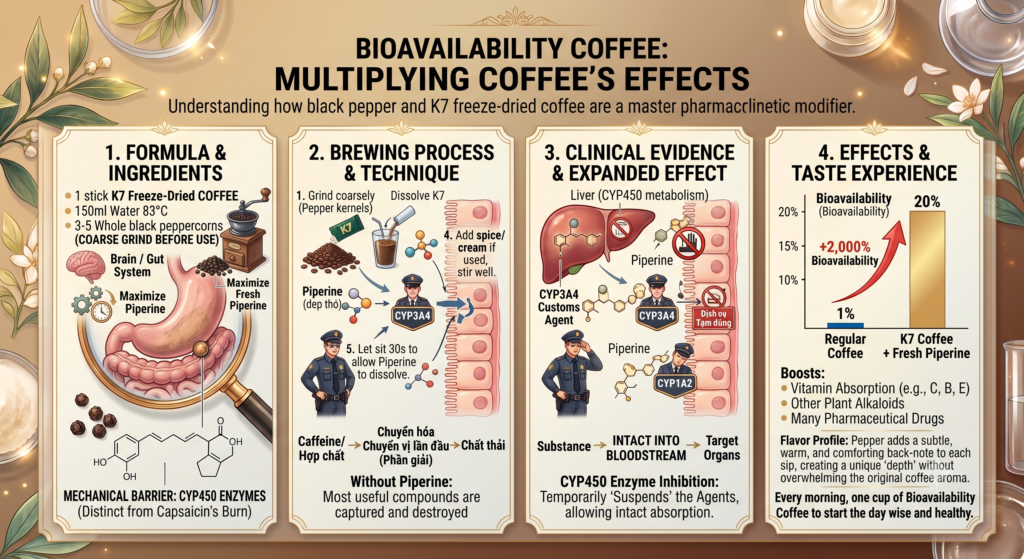
- Coarsely grind 3–5 black peppercorns using a mini grinder or hand mortar don’t grind it into a fine powder; keeping it slightly coarse lets piperine release gradually into the water.
- Dissolve the K7 CAPHE stick in 150ml of 83°C water.
- Add the ground black pepper and stir well for 10 seconds.
- Add the cinnamon or turmeric if using, stirring for another 10 seconds.
- Let it sit for 30 seconds before drinking so the piperine dissolves more fully.
Important grind the pepper right before use: piperine oxidizes quickly when exposed to air. Pre-ground pepper that’s sat in a jar for months has already lost most of its piperine what’s left is mostly the spicy taste with little biological effect. Grinding right before use ensures you get fresh, intact piperine. 3–5 peppercorns a day, 30 seconds in a mini grinder, is all it takes.
Flavor: black pepper adds a light, warm note at the end of each sip not enough to overpower the coffee, just enough to create an interesting warm finish. Many people describe it as making the coffee taste “deeper” without being able to explain exactly why.
Safe dosage and what to know
| Note | Detail |
|---|---|
| Effective and safe dosage | Studies using piperine typically use 5–20mg/day. An average peppercorn contains about 1–2mg of piperine, meaning 3–5 ground peppercorns provide roughly 5–10mg within the effective, safe range for most people. Don’t exceed about 20mg/day (roughly 10–15 peppercorns) when starting out. |
| A warning for people on medication | The CYP450 enzymes piperine inhibits are also responsible for metabolizing a wide range of medications including statins, some blood-pressure drugs, blood thinners, fluoroquinolone antibiotics, and more. Inhibiting CYP450 can raise drug concentrations in the blood above therapeutic levels. Ask your doctor or pharmacist before adding black pepper regularly if you’re on any prescription medication. Black pepper used in ordinary cooking (small, irregular amounts) carries a lower interaction risk than a daily supplement dose. |
| Freshly ground pepper >> pre-ground pepper | Piperine oxidizes quickly. A bag of whole peppercorns stored properly (sealed jar, away from light) retains far more piperine than pre-ground pepper. Investing in a small pepper grinder (about 100,000–200,000 VND) is worth it if you actually want the benefit. |
The smallest upgrade, the biggest impact
Looking back across this whole spice series (from coffee + cinnamon to coffee + black turmeric), black pepper is the only ingredient that amplifies the effect of everything else cinnamon, turmeric, collagen, and even the caffeine in the coffee itself. It isn’t a standalone spice like ginger or cinnamon it’s the “multiplier” for the entire formula. If you can only make one single change to your morning cup, 3 freshly ground black peppercorns in K7 CAPHE is the smallest upgrade with the biggest potential impact, by cost-to-benefit.
Frequently asked questions about coffee with black pepper
What is piperine, and what does it do? Piperine is the alkaloid that gives black pepper its spicy heat, making up about 5–9% of a dried peppercorn’s weight. It inhibits CYP450 enzymes (CYP3A4, CYP1A2) in the gut and liver, slowing the breakdown of various compounds before they reach the bloodstream, which boosts their bioavailability most famously, boosting curcumin absorption by 2,000% according to a study in Planta Medica (1998).
How does black pepper help absorb caffeine better? Piperine inhibits CYP1A2, the main enzyme that metabolizes caffeine in the liver, so caffeine stays in the bloodstream longer. The result is an alertness effect that lasts 30–60 minutes longer than coffee without pepper, using the same amount of caffeine.
How many peppercorns should I use per day? 3–5 freshly ground peppercorns (about 5–10mg of piperine) is enough and sits within the safe, effective range for most people. Don’t exceed roughly 10–15 peppercorns (20mg of piperine) a day when starting out.

Who shouldn’t add black pepper regularly? People on prescription medication especially statins, blood-pressure drugs, blood thinners, or fluoroquinolone antibiotics should check with a doctor or pharmacist first, since piperine can raise these drugs’ blood concentrations above therapeutic levels.
Why grind pepper right before use instead of buying it pre-ground? Piperine oxidizes quickly when exposed to air. Pre-ground pepper that’s sat around for a while has already lost most of its piperine, leaving mostly the spicy taste with little biological effect. Grinding right before use keeps the piperine fresh and intact.
Can I combine black pepper with cinnamon and black turmeric at the same time? Yes. That’s exactly the upgraded “Bioavailability Coffee” recipe adding 1/4 teaspoon of Ceylon cinnamon and/or 1/4 teaspoon of ground black turmeric alongside 3–5 black peppercorns creates a three-way synergy between piperine, curcumin, and caffeine.
K7 CAPHE freeze-dried coffee Vietnamese Arabica (Cầu Đất & Khe Sanh) blended with Đắk Lắk Robusta, no additives, no flavorings is the ideal base for every spice “upgrade” to reach its full potential. Add 3 freshly ground black peppercorns tomorrow morning and start noticing the difference within a few weeks.
Domestic customers: Buy now on our website or on e-commerce platforms: Buy now — Shopee K7 CAPHE
International customers: Please contact us for assistance: Contact K7 CAPHE
