




“Beauty Coffee” is taking over Instagram and TikTok bright, aesthetic videos of coffee being mixed with a scoop of fine white collagen powder, captioned with promises of plump skin and stronger nails. But here’s the real question: is this science, or just well-packaged marketing? The answer is more complicated than you’d think and more honest than what most influencers say.
Collagen and the body: getting it right before you spend the money
Before asking whether drinking collagen actually works, it helps to understand what collagen really is and how the body processes it.
What collagen is: Collagen is the most abundant protein in the human body making up about 30% of total protein and forming the main structural component of skin, tendons, ligaments, cartilage, bone, and blood vessel walls. In skin, collagen forms the underlying protein network a “scaffold” that keeps skin firm, elastic, and hydrated. When that scaffold is dense and healthy, skin looks plump and smooth; as it weakens and thins out, wrinkles and sagging appear.
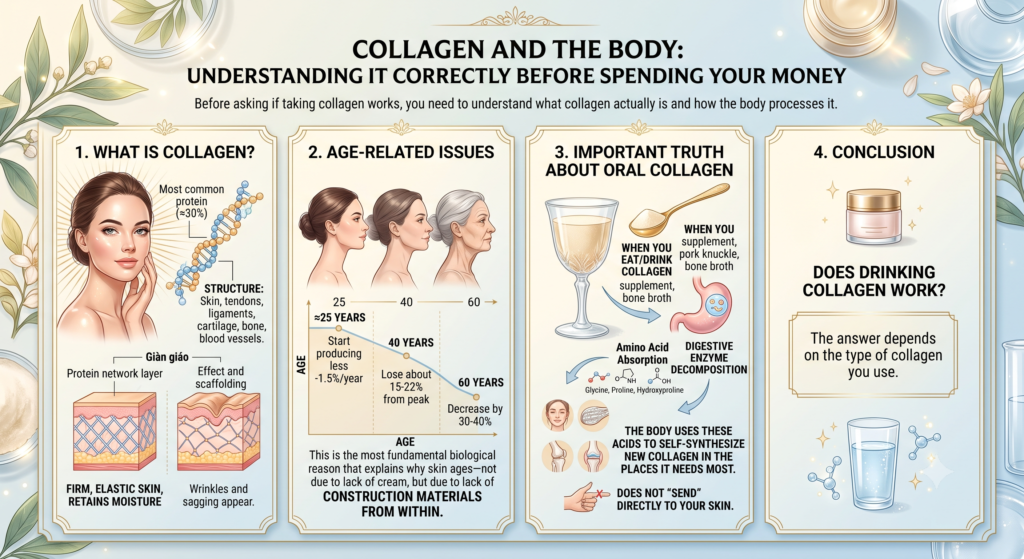
The problem with age:
| Age milestone | Collagen lost compared to peak levels |
|---|---|
| From age 25 | Decline begins, averaging about 1–1.5% per year |
| By age 40 | Roughly 15–22% |
| By age 60 | Can reach 30–40% |
This is the most basic biological reason skin ages not a lack of moisturizer, but a lack of raw building material from within.
An important truth about drinking collagen: this is where many people get it wrong. When you eat or drink collagen whether from pork trotters, bone broth, or a collagen supplement powder your body doesn’t “send” that collagen straight to your skin. Instead, digestive enzymes break collagen down into individual amino acids (glycine, proline, hydroxyproline) before absorption, and the body then uses those amino acids to synthesize new collagen wherever it’s needed most. So does drinking collagen actually work? The answer depends on which form of collagen you use.
Regular collagen vs. collagen peptides: the difference that decides everything
| Criteria | Regular collagen (bone broth, pork trotters, cooked pork skin) | Collagen peptide (hydrolyzed collagen) |
|---|---|---|
| Molecule size | Large molecules, fully broken down into ordinary amino acids before absorption | Pre-hydrolyzed into shorter fragments (2,000–5,000 Daltons) |
| Absorption | Absorbed like ordinary protein | Better gut absorption thanks to its smaller size |
| Effect on skin | No specific evidence of skin improvement compared to protein from chicken or eggs | Once in the bloodstream, accumulates in the dermis and stimulates fibroblasts to synthesize new collagen |
| Significance | Good for general health (provides protein) | Doesn’t just provide raw material, it “signals” skin cells to produce more collagen |
This is a crucial mechanistic difference: collagen peptide isn’t just a building material — it’s a biological signal.
The scientific evidence: does it actually work?
This is where the story gets interesting and diverges from what most influencers say.
A meta-analysis published in the Journal of Drugs in Dermatology (2021), pooling data from 19 randomized controlled clinical trials with a total of 1,125 participants, found that taking collagen peptide at 2.5–10g/day for at least 8 weeks produced statistically significant improvements in skin elasticity, skin hydration, dermal collagen density, and reduced wrinkle depth. The effect was more pronounced in people over 35, a group whose baseline collagen has already declined substantially.
That said and this part matters results varied considerably between studies. Some showed only modest improvement, study quality was inconsistent, and many were funded by the supplement industry. On top of that, the following factors matter more than collagen peptide for protecting skin over time:
| Factor | Why it matters |
|---|---|
| Daily sunscreen (SPF 30+) | UV damages collagen faster than anything you drink can compensate for |
| Enough sleep (7–9 hours) | Nighttime growth-hormone release is when collagen synthesis is most active |
| Not smoking | Nicotine reduces blood flow to the skin and inhibits the hydroxylase enzymes needed for collagen synthesis |
| Adequate vitamin C | An essential cofactor in the hydroxylation of proline and lysine — a key step in the collagen-synthesis chain |
Bottom line: collagen peptide is a supplement with reasonable evidence behind it not a miracle, but not a scam either. If you’ve already got the basics right (SPF, enough sleep, no smoking), adding collagen peptide can provide a meaningful additional layer of support, especially from age 30 onward.
Why is additive-free cold-dried coffee the best base for Beauty Coffee?
Not every coffee makes a good base for Beauty Coffee and here’s specifically why additive-free cold-dried coffee like K7 CAPHE has an edge:
- No sugar = no glycation: this is a point few people know, but it’s critical. Glycation is the process where blood sugar attaches to proteins — including collagen — forming advanced glycation end-products (AGEs). AGEs make collagen fibers stiff, brittle, and less elastic. When you add sugar to your coffee every morning, you’re drinking collagen and creating the conditions to destroy it at the same time. A sugar-free cup removes that contradiction entirely.
- Antioxidants that protect existing collagen: polyphenols in Arabica coffee, especially chlorogenic acid, which is well preserved in cold-drying, are powerful antioxidants that neutralize the reactive oxygen species that constantly attack and break down collagen fibers in the skin. Drinking high-quality cold-dried coffee can protect the collagen you already have, not just help build new collagen.
- Cold-drying preserves polyphenols: spray-drying at high heat destroys a significant portion of chlorogenic acid, while cold-drying at -40°C preserves nearly all of it. That means each stick of K7 CAPHE delivers noticeably more antioxidant content than the same amount of regular spray-dried instant coffee.
The “Beauty Latte” recipe with K7 CAPHE, try it tomorrow morning
Ingredients
| Ingredient | Amount |
|---|---|
| K7 CAPHE cold-dried coffee | 1 stick |
| Water at 83°C | 100ml |
| Collagen peptide powder (marine or bovine) | 10g |
| Unsweetened macadamia milk (or unsweetened dairy milk, almond milk) | 150ml |
| Vitamin C powder — ascorbic acid (optional, boosts collagen synthesis) | 1/2 teaspoon |
| Ice cubes (optional, for a cold version) | As needed |
Method
- Dissolve the K7 CAPHE stick in 100ml of 83°C water, stirring well.
- Add 10g of collagen peptide to the still-hot coffee, stirring vigorously for 20–30 seconds until fully dissolved collagen peptide dissolves well in warm water and won’t clump if stirred properly.
- Add the macadamia milk, stirring gently or using a milk frother for foam.
- Add the vitamin C if using, stirring for another 5 seconds.
- Drink right away or add ice — every morning, for at least 8 consecutive weeks.
Flavor: warm caramel coffee blended with lightly rich macadamia milk, good-quality collagen peptide is nearly flavorless and doesn’t affect the coffee experience. This is what surprises most people: Beauty Coffee doesn’t taste “fishy” or “off” it’s just a slightly better latte with an added benefit.

What to know before you start
Choosing the right type of collagen peptide
| Type | Characteristics |
|---|---|
| Marine collagen (from fish) | Rich in Type I collagen — the most common type in skin. Absorbs faster than bovine, smaller molecule size. Better suited if skin is your main goal. Usually more expensive. |
| Bovine collagen (from cattle) | Contains both Type I and Type III — Type III is important for elasticity and elastin. Cheaper than marine, comparably effective for most people. Avoid if you’re concerned about BSE (mad cow disease) choose marine instead. |
Other notes
| Note | Detail |
|---|---|
| Don’t mix with boiling (100°C) water | Collagen peptide partially denatures above 90°C not destroyed entirely, but its effectiveness may drop. Brewing K7 CAPHE at 83°C is ideal: hot enough to dissolve collagen well, not hot enough to damage the peptide structure. |
| It takes time — don’t give up early | Results need at least 8 weeks of consistent use before showing up. Collagen synthesis is slow, it’s a biological process, not an Instagram filter. If you stop after 3 weeks because you “don’t see anything,” you’re quitting right as your body starts responding. |
| Doesn’t replace basic skincare | Drinking collagen peptide every morning without daily sunscreen is like working out hard but never sleeping enough a big part of the benefit gets cancelled out. Beauty Coffee is an added layer, not a replacement for SPF, retinol, and moisturizer. |
| Don’t forget vitamin C | Hydroxyproline and hydroxylysine two amino acids essential to collagen’s structure are synthesized by the enzymes prolyl hydroxylase and lysyl hydroxylase, both of which require vitamin C as a cofactor. Without enough vitamin C, these enzymes can’t function, and collagen won’t be synthesized properly even if you have plenty of raw material. |
Frequently asked questions about Beauty Coffee with collagen
Does drinking collagen actually improve skin? There’s reasonable evidence, but it’s not a miracle. A meta-analysis in the Journal of Drugs in Dermatology (2021), pooling 19 trials with 1,125 participants, found that collagen peptide at 2.5–10g/day for at least 8 weeks significantly improved skin elasticity, hydration, and reduced wrinkles most noticeably in people over 35.
What’s the difference between regular collagen and collagen peptide? Collagen peptide is pre-hydrolyzed into short fragments (2,000–5,000 Daltons), absorbs better through the gut, and has a specific mechanism of stimulating fibroblasts to make new collagen. Regular collagen (bone broth, pork trotters) provides only ordinary protein, with no specific evidence of skin improvement.
Should I choose marine or bovine collagen? Marine collagen is rich in Type I, absorbs faster, and suits you better if skin is your main goal, though it costs more. Bovine collagen contains both Type I and Type III (good for elasticity), costs less, and is comparably effective for most people — unless you’re concerned about BSE, in which case marine is the safer choice.
How long does it take to see results? At least 8 weeks of consistent use. Collagen synthesis follows a slow, natural biological process, not an instant effect stopping after 2–3 weeks because “nothing’s happening” means quitting right when your body is starting to respond.
Why shouldn’t I mix collagen with boiling (100°C) water? Collagen peptide partially denatures above 90°C, which can reduce its effectiveness. Brewing K7 CAPHE at 83°C is ideal hot enough to dissolve it well, but not hot enough to damage the peptide structure.
Can Beauty Coffee replace sunscreen? No. Daily SPF 30+ matters more than any collagen supplement for protecting skin, since UV damages collagen faster than anything you drink can make up for. Beauty Coffee is an added layer, not a substitute for basic skincare.
No sugar to avoid glycation. Polyphenols from cold-dried Arabica to protect existing collagen. Collagen peptide to stimulate new synthesis. Vitamin C to keep the enzymes working. All in one morning cup, in under 2 minutes this is a Beauty Coffee that’s actually grounded in science. K7 CAPHE cold-dried coffee, Vietnamese Arabica (Cầu Đất & Khe Sanh) blended with Đắk Lắk Robusta. No additives, no flavorings, no added sugar base the perfect foundation for your own Beauty Coffee.
Domestic customers: Buy now on our website or on e-commerce platforms: Buy now — Shopee K7 CAPHE
International customers: Please contact us for assistance: Contact K7 CAPHE
