




Do you drink coffee the moment you wake up at 6–7am? It feels familiar, almost like a ritual to start the day. But modern neuroscience says something quite different: this habit is making caffeine lose its effectiveness faster, making you more dependent on coffee every week while you still feel tired even after drinking it. The mystery lies in a concept called the “caffeine window.”
Morning cortisol: the natural alertness weapon you’re wasting
To understand why the timing of your coffee matters, you first need to understand what happens inside your body the moment you wake up.
Between roughly 6 and 9am, your adrenal glands produce cortisol at the highest level of the day. Cortisol often mistakenly labeled a negative “stress hormone” is actually the body’s most important hormone for alertness and energy regulation. It’s responsible for raising heart rate, stabilizing blood sugar, and activating the brain in the morning. In simpler terms: cortisol is already doing the job of waking your body up completely free and natural, with no caffeine required.
So what happens when you drink coffee right as cortisol is at its peak?
Caffeine works by blocking adenosine a chemical that accumulates in the brain while you’re awake and causes drowsiness. But when cortisol is already keeping adenosine naturally suppressed, your body doesn’t really “need” caffeine for extra alertness yet. At that point, caffeine doesn’t make you much more alert but it does push your body to build tolerance to caffeine faster.
The result after a few weeks of drinking coffee right when you wake up: you need more and more caffeine to reach the same level of alertness. A cycle of dependency begins to form not because of weak willpower, but because you’re drinking the right thing at the wrong time.
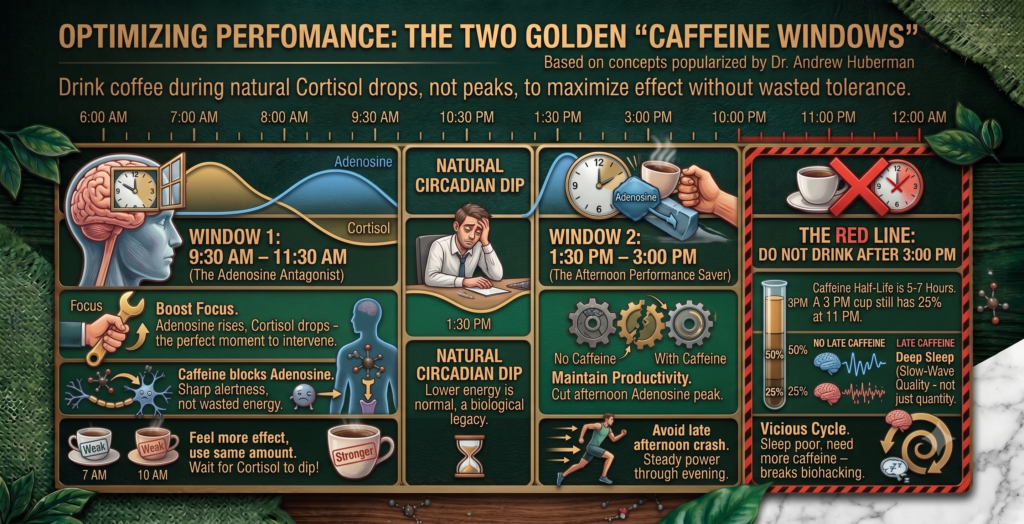
What is the “caffeine window”? Two golden windows in the day
The concept of the “caffeine window” was popularized widely by Dr. Andrew Huberman a neuroscientist at Stanford and is now widely applied within the global performance-optimization (biohacking) community.
The core idea is simple: drink caffeine when cortisol is naturally declining, not when it’s at its peak. At that point, caffeine fills exactly the gap your body needs, delivering its maximum effect without going to waste or building tolerance too quickly.
First window: 9:30 – 11:30am
This is the most golden window of the day. After cortisol starts declining from its morning peak, adenosine gradually begins accumulating again, creating that foggy, hard-to-focus feeling. This is exactly when caffeine should show up it blocks adenosine right on time, giving you sharper alertness than drinking at 6–7am would, extending your focus all the way through midday.
Many people report that after switching from a 7am coffee to a 9:30–10am coffee, the coffee feels “stronger” even at the same dose it’s not actually stronger, it’s that the body is absorbing and responding to the caffeine more effectively.
Second window: 1:30 – 3:00pm
This is the biological “slump point” almost everyone experiences after lunch not because of overeating, but because the human circadian rhythm naturally includes a low-energy phase in the early afternoon, a leftover trait from our ancestors’ habit of short midday rest.
A cup of coffee in this window cuts off the afternoon’s adenosine peak right on time, helping you maintain performance through 5–6pm without a sudden energy crash.
The red line: no coffee after 2–3pm
This is the most important rule and also the most commonly ignored. Caffeine has an average half-life of about 5–6 hours in a healthy adult (it can range from 4–8 hours depending on the individual) meaning if you drink a cup of coffee at 3pm, a significant amount of caffeine is still circulating in your blood by 9pm. By 11pm when many Vietnamese people go to bed some of that caffeine still hasn’t been fully cleared.
Caffeine doesn’t necessarily keep you from falling asleep but it can reduce the quality of your deep sleep (slow-wave sleep), even if you’re still able to sleep normally. And reduced deep sleep quality means you wake up still tired, need more coffee, and the cycle continues.
Why is freeze-dried arabica better suited to the caffeine-window strategy?
Not every coffee is equal when applying this strategy and this is where freeze-dried Arabica has a clear advantage.
A moderate, non-overwhelming caffeine dose: Arabica contains around 1.2% caffeine, significantly lower than Robusta’s roughly 2.7%. One K7 CAPHE freeze-dried stick (2g) delivers about 60–80mg of caffeine enough to trigger focus, but not enough to cause anxiety, a racing heart, or trouble sleeping if consumed within the right window. This is a “smart” dose of caffeine effective without uncomfortable side effects.
Slower, more sustained absorption thanks to polyphenols: High-quality Arabica, especially when freeze-dried (which preserves its chlorogenic acid content), contains more polyphenols. These compounds slow down how quickly caffeine gets absorbed into the bloodstream, creating a gradual rise-and-fall energy curve instead of a sharp spike followed by a sudden crash. You stay alert for longer, without that abrupt “power-down” feeling after 1–2 hours.
No sugar means no sugar crash: One of the most common reasons people feel tired after a sweet coffee is a sugar crash blood sugar spikes, then drops sharply within 60–90 minutes, causing sluggishness and cravings for more sugar. K7 CAPHE freeze-dried coffee has no additives and no added sugar completely removing that mechanism from your energy equation.
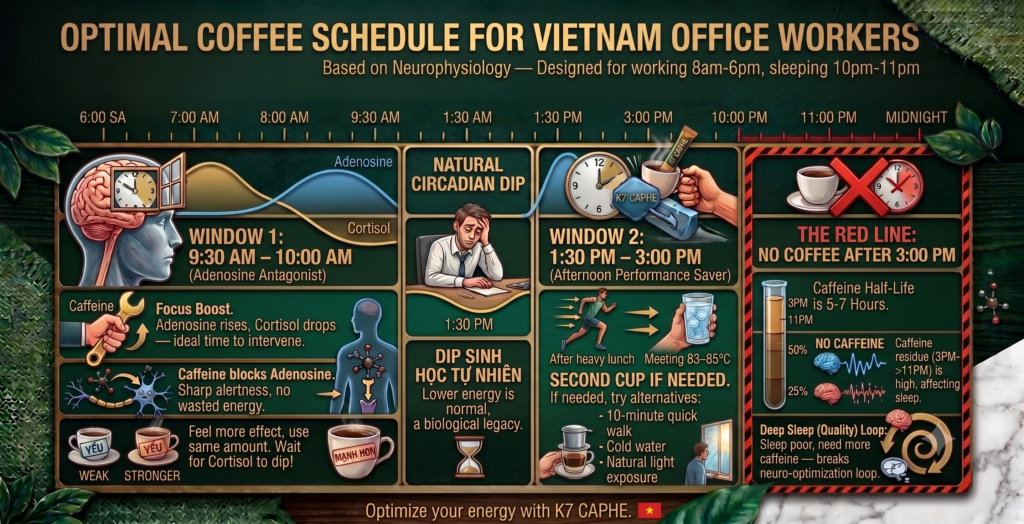
An optimal coffee schedule for Vietnamese office workers
Here’s a suggested coffee schedule based on common circadian rhythm patterns designed for people working 8am to 5–6pm and sleeping around 10–11pm:
- 6:00 – 9:00am: Drink water, no coffee. Let cortisol do its job naturally. If your morning routine includes exercise, this is the ideal time, since high cortisol supports better workout performance.
- 9:30 – 10:00am: Your first cup — one K7 CAPHE freeze-dried stick, black, with 83–85°C water. This is your “golden window” caffeine delivers its maximum effect, helping you focus sharply on the day’s most important tasks.
- 1:30 – 2:00pm: A second cup if needed — especially after a heavy lunch or on days with long afternoon meetings. This should be the last coffee of the day if you sleep before 11pm.
- After 3:00pm: No coffee. If you still need a boost, try a brisk 10-minute walk, a glass of cold water, or exposure to natural light these naturally support alertness without affecting your sleep later that night.
The truth about caffeine and sleep few people say out loud
There’s a common misconception worth clearing up: many people assume that because they can “drink coffee at night and still sleep fine,” caffeine doesn’t affect their sleep at all.
That’s not entirely accurate.
Caffeine doesn’t necessarily keep you from falling asleep but numerous sleep-biology studies have found that it can quietly reduce the proportion of deep sleep (slow-wave sleep), the stage during which the brain processes memories, the body repairs cells, and the immune system regenerates even when caffeine is consumed several hours before bedtime and doesn’t make falling asleep feel any harder. You might sleep a full 8 hours, but only part of that time is truly deeply restorative and the next morning you’re still tired, still reaching for coffee the moment you wake up, and the cycle continues.
This is an invisible effect that accumulates day by day, gradually eroding cognitive, emotional, and physical capacity.
The final takeaway: adequate, deep sleep is the real foundation of sustained alertness. Caffeine is a fantastic tool when used correctly but it can’t replace sleep, and using it the wrong way will gradually undermine the very foundation it was meant to support.
Frequently asked questions
What’s the best time of day to drink coffee? The two golden windows are 9:30–11:30am and 1:30–3:00pm, when cortisol is naturally declining and adenosine starts building back up. Avoid drinking coffee right after waking (6–9am) and after 3pm.
Why shouldn’t I drink coffee right when I wake up? Because at that time, cortisol your natural alertness hormone is at its peak, and your body doesn’t yet truly “need” caffeine. Drinking at this point causes your body to build tolerance to caffeine faster, leading to needing higher doses over time.
How long does caffeine stay in your system? The average half-life of caffeine in a healthy adult is about 5–6 hours, ranging from 4–8 hours depending on the individual. This means a meaningful amount of caffeine can still be in your bloodstream many hours after you drink it.
Does afternoon coffee affect sleep? It can, even if you’re still able to fall asleep normally. Caffeine can reduce the quality of your deep sleep, leaving your body less rested even when your total sleep time is sufficient.
What is the caffeine window? It’s a concept describing the times of day when drinking caffeine delivers the most effective boost in alertness, based on cortisol’s natural decline pattern popularized widely by Dr. Andrew Huberman and the global biohacking community.
Note: The content above is a general suggestion based on common circadian rhythm patterns, not personalized medical advice. Caffeine needs and circadian rhythms can vary from person to person. If you have a heart condition, anxiety, a sleep disorder, or are pregnant or breastfeeding, consult a doctor before adjusting your caffeine habits.

Drink at the right time, with the right coffee start with K7 CAPHE
Just the right amount of caffeine from high-quality Vietnamese Arabica, no additives, no added sugar, authentic flavor preserved through freeze-drying — K7 CAPHE is designed to fit perfectly within your caffeine window. Brew at 9:30am, stay focused until noon. Brew at 1:30pm, maintain your performance through the afternoon. Simple, and backed by science.
Domestic customers: Order now via our website or e-commerce platform: Buy now — K7 CAPHE on Shopee
International customers: Please reach out to us directly: Contact K7 CAPHE
