




Colombia and Brazil, two giants of world coffee exports, ranked first and third globally in production. But pour the same amount of hot water into two freeze-dried coffee packets from these two countries and taste them side by side, and you’ll feel like you’re drinking two completely different beverages almost hard to believe they come from the same plant species.
Two giants, two completely opposite coffee philosophies
When people think of South American coffee, Colombia and Brazil are usually the first names that come to mind and that’s no accident. Together, these two countries account for nearly half of the world’s total coffee production. But here’s the interesting part: despite sharing a continent, growing the same Arabica species, and exporting to markets worldwide, Colombia and Brazil represent two almost entirely opposite coffee philosophies.
Colombia is a country of refinement and depth where the rugged terrain of the Andes becomes a remarkable advantage, forcing everything to be hand-picked, slowly and carefully.
Brazil is a country of scale and the perfection of simplicity where sprawling coffee fields stretch as far as the eye can see, heavily mechanized, producing a raw material so consistent, full-bodied, and reliable that it forms the backbone of most espresso blends worldwide.
Two philosophies, two lands, two cups of coffee and when both are processed through freeze-drying technology, that difference comes through more clearly and honestly than ever before.
Colombian Huila, a refined gem between two branches of the Andes
Huila is a province in southwestern Colombia, wedged between the Central and Eastern branches of the Andes at an elevation of 1,200–2,000 meters. It sounds like just another point on a map but for Arabica coffee, it’s paradise.
The two mountain ranges create an extraordinary microclimate effect: cold air rolls down from the peaks at night, warm air rises up from the valley during the day — a day-night temperature swing of 15–20°C. Coffee cherries grown under these conditions ripen extremely slowly, accumulating sugars and complex flavor compounds in a way that flat, temperature-stable land simply can’t replicate.
On top of that, Huila’s steep terrain makes mechanized harvesting nearly impossible everything is picked by hand, cherry by cherry, only once evenly ripe and red. That means every bean that reaches you has been personally inspected and selected by someone.
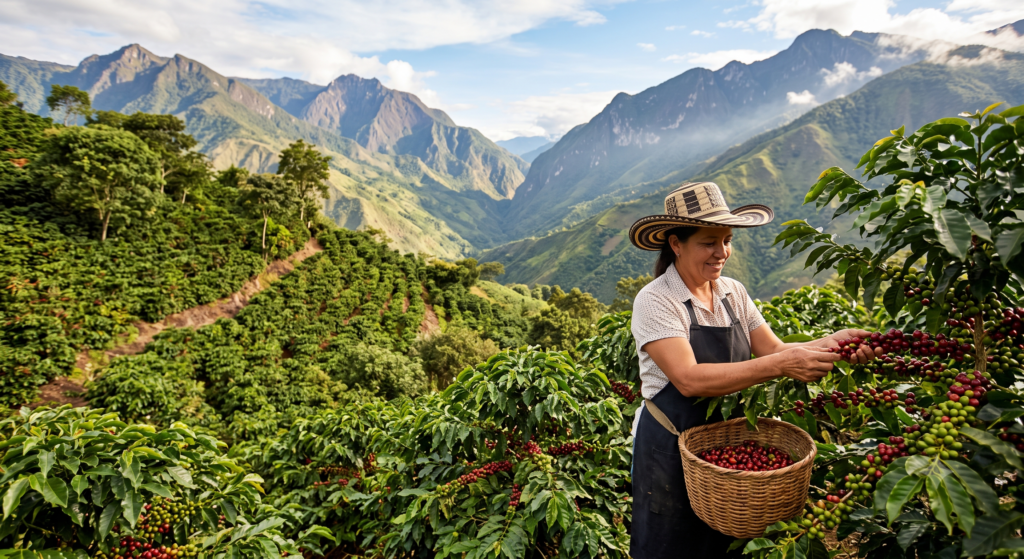
Flavor portrait of Colombian Huila:
- Aroma when brewing: Warm brown caramel, lightly roasted hazelnut, a subtler hint of jasmine than Ethiopia friendly and inviting from the very first moment
- Dominant flavor: Ripe red apple, sweet orange, apricot — fruity but never sharply sour, sweet but never cloying. This is why Colombia is often described as “balanced” — it doesn’t excel dramatically in any one dimension, but it’s excellent across all of them at once
- Body: Medium-full — full enough to be satisfying, yet light enough to drink all day without feeling heavy
- Acidity: Gentle and balanced — enough to add brightness, never enough to be off-putting. This is the kind of acidity even people who usually complain about “sour coffee” can enjoy
- Finish: Sweet caramel, moderately long — clean and pleasant
Colombian Huila regularly scores above 85 on the Q scale and it’s no surprise that many coffee experts call it “the most balanced coffee in the world,” suited to almost every brewing method and almost every drinker.
Brazilian Cerrado, when simplicity is elevated into an art form
Cerrado is a vast tropical savanna region in central Brazil, spanning the states of Minas Gerais, Goiás, and Bahia. A world apart from Colombia’s rugged mountain terrain, Cerrado is flat and expansive, sitting at just 800–1,200 meters, with a distinct dry season lasting 5–6 months.
Those conditions produce a completely different kind of coffee: not refined, not complex in the way Colombia or Ethiopia are but with something few coffees achieve: perfection through simplicity. Every sip of Cerrado is consistent, predictable, and satisfying like a classic song you’ve heard a hundred times and still never get tired of.
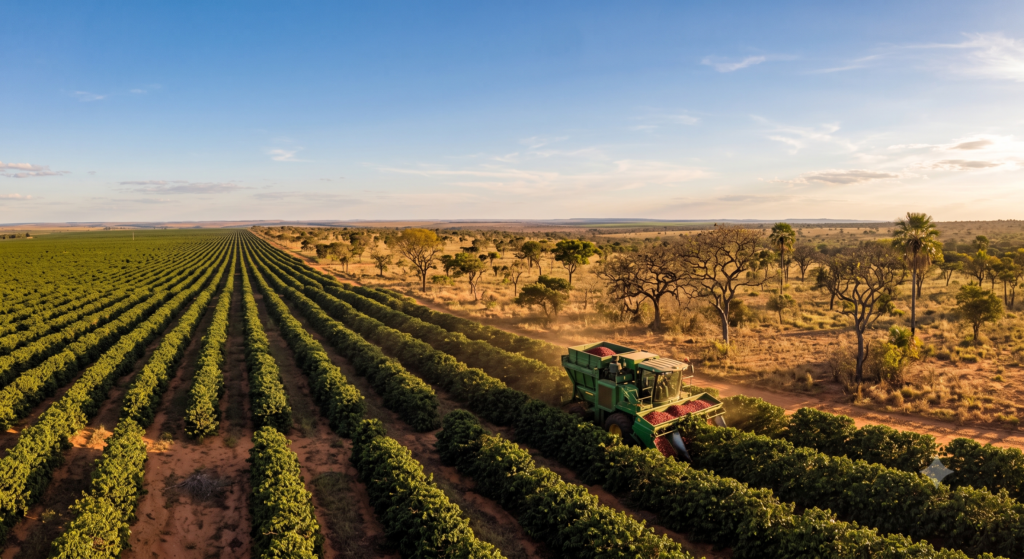
Flavor portrait of Brazilian Cerrado:
- Aroma when brewing: Warm milk chocolate, roasted chestnut, caramel — like the smell of a bakery in the morning, impossible to resist
- Dominant flavor: Light dark chocolate, brown sugar, macadamia nut — rich, warm, and extremely easy to drink. No sour notes, no surprises — just pure satisfaction
- Body: Heavy and full — this is Cerrado’s greatest strength. As you drink, you can feel the coffee’s “weight” in your mouth in a genuinely pleasant way
- Acidity: Low — nearly imperceptible. This is why Brazil is the go-to choice for anyone whose stomach is sensitive to acidity
- Finish: Shorter than Colombia or Ethiopia — but clean, with no unpleasant aftertaste
It’s easy to see why most of the world’s espresso blends are built on a Brazilian foundation: heavy body, bold chocolate notes, low acidity, and rock-solid consistency from batch to batch exactly what an espresso base needs.
Head-to-head: what happens when both meet freeze-drying technology
This is the most interesting part and the reason freeze-drying is the only way to truly taste and compare these two lands without needing professional brewing equipment.
Traditional spray-drying flattens flavor it turns everything into a neutral shade of brown dominated by bitterness. Freeze-drying is different: it preserves each region’s “signature” within every particle of powder, and when you dissolve it in water, that signature comes through honestly and clearly.
Drink freeze-dried Colombian Huila, and you’ll immediately notice its brightness, freshness, and depth of flavor. Layers unfold one after another caramel first, then orange, then a touch of floral as the temperature in your mouth gradually cools.
Drink freeze-dried Brazilian Cerrado, and you’ll immediately notice its fullness, smoothness, and consistency. No surprises, no complex layers just warm chocolate and caramel from start to finish, with a heavy, satisfying body.
Why does a blend often beat single-origin for everyday freeze-dried coffee?
This is an endless debate in the specialty coffee community and the answer depends on what you want from your cup.
Single-origin coffees like Colombian Huila or Brazilian Cerrado offer a pure, distinctive experience the perfect choice when you want to explore and learn about the flavor of a specific place, or when you’re enjoying coffee as a slow, focused ritual.
But for everyday drinking your first cup at 9:30am, your second after lunch single-origin can sometimes feel too “one-note”: Colombia can be too floral and fruity for someone used to bold coffee, while Brazil can feel too flat and understated for someone accustomed to specialty coffee.
Blending solves that by taking each region’s strengths and letting them cover for the other’s weaknesses. Brazil brings heavy body and consistency; Colombia brings flavor depth and balance. Put together, you get a cup that’s full-bodied, flavorful, and easy to drink never too extreme in either direction.
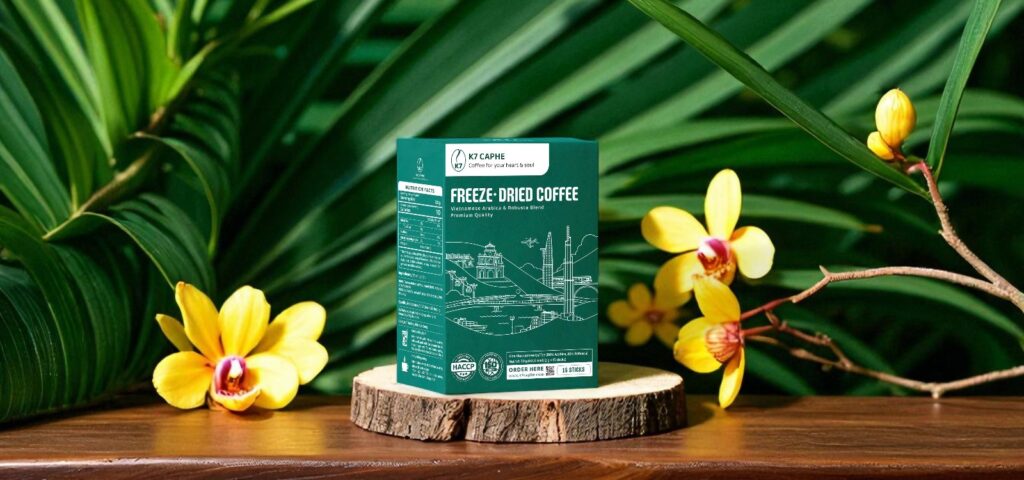
That’s exactly the logic K7 CAPHE applies with Vietnamese ingredients: Arabica from Cầu Đất and Khe Sanh plays the role of “Colombia” in the blend bringing delicate aroma, natural sweetness, and flavor depth. Đắk Lắk Robusta plays the role of “Brazil” full body, thick crema, and rock-solid consistency from cup to cup.
Freeze-drying is the glue that binds these two worlds together preserving every strength, losing nothing in the process of turning them into a convenient instant product.
Frequently asked questions
What’s the difference between blend and single-origin coffee? Single-origin coffee comes from one specific growing region, carrying the pure, distinctive flavor of that terroir. A blend combines beans from two or more regions or varieties, mixed to balance out each other’s strengths and weaknesses, producing a flavor that’s more balanced and consistent.
Should I choose Colombia or Brazil for everyday drinking? If you enjoy layered, fruity coffee with noticeable acidity, choose Colombia. If you prefer bold, chocolatey coffee that’s low in acidity and easy to drink all day, choose Brazil. If you want both strengths at once, a blend that balances the two styles is the better fit.
Why is Brazil the foundation of most espresso blends? Because Brazilian Cerrado has a heavy body, low acidity, and consistent quality from batch to batch exactly what an espresso base needs to build thick crema and a reliably bold flavor.
Does freeze-drying preserve the differences between coffee regions? Yes. Because no heat is used in forming the powder, freeze-drying preserves each region’s distinctive flavor compounds almost intact unlike traditional spray-drying, which tends to flatten the flavor differences between origins.
Experience the art of blending in every K7 CAPHE stick
You don’t need to fly to Colombia or Brazil to understand why a blend beats single-origin. One stick of freeze-dried K7 CAPHE gives you the answer — fragrant like Arabica, bold like Robusta, clean thanks to freeze-drying technology, and as convenient as a compact stick in your pocket.
K7 CAPHE freeze-dried coffee — Vietnamese Arabica (Cầu Đất & Khe Sanh) blended with Đắk Lắk Robusta. No additives, no artificial flavoring. Authentic flavor, ready in 30 seconds.
Domestic customers: Order now via our website or e-commerce platform: Buy now — K7 CAPHE on Shopee
International customers: Please reach out to us directly: Contact K7 CAPHE
