




Nobody puts jasmine in a cup of coffee not a single petal, not a drop of essential oil, no artificial flavoring at all. Yet when you bring a cup of Yirgacheffe to your nose, the scent of jasmine appears so clearly that you’ll almost want to check whether someone slipped something into it. This isn’t an illusion. It’s one of the most wonderful and fascinating scientific phenomena in the world of coffee.
(A quick note: K7 CAPHE does not use Yirgacheffe Arabica in its products. This article is a journey into one of the world’s most legendary coffee regions so you can better understand why terroir matters, and why Vietnamese Arabica from Cầu Đất & Khe Sanh deserves to tell its own story in the same way.)
What is Yirgacheffe, and why does the whole coffee world know this name?
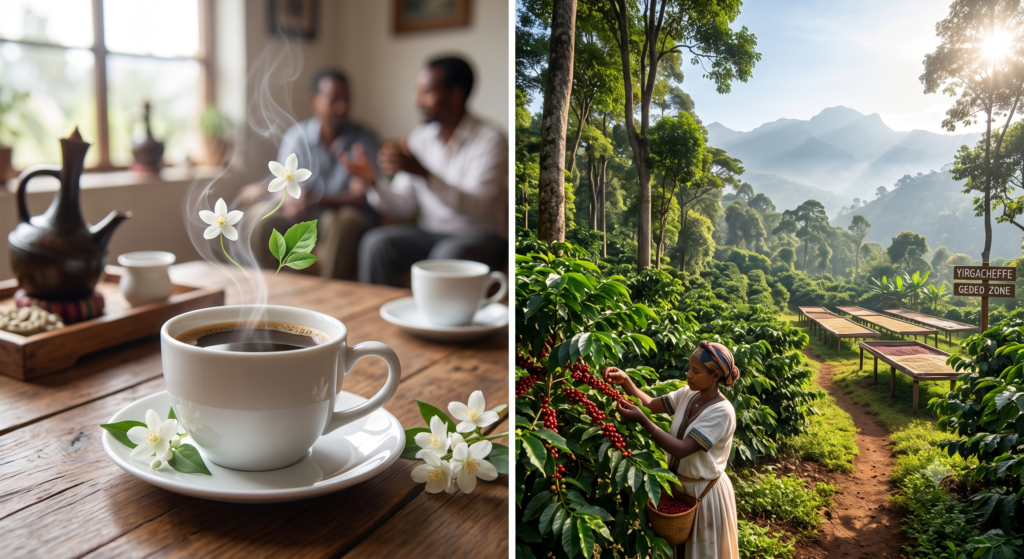
Yirgacheffe (pronounced “yir-ga-chef”) is a small town in southern Ethiopia, in the Gedeo zone sounds unremarkable at first. But in the global specialty coffee community, this name carries the same weight as Champagne in the world of sparkling wine, or Kobe in the world of beef.
And just like Champagne or Kobe, Yirgacheffe is protected by an official Geographic Indication (GI) making it one of the first coffee regions in Africa to receive this kind of recognition. That means not every coffee grown in Ethiopia can be called Yirgacheffe only beans from the exact designated geographic area, meeting the required quality standards, can carry that prestigious name.
So what makes Yirgacheffe’s appeal so irresistible?
It all starts with geographic conditions no other place on earth can replicate: an altitude of 1,700–2,200 meters, a stable year-round climate, evenly distributed rainfall, and most remarkably coffee trees growing wild among the native forest, known as “garden coffee” or “forest coffee.” These trees aren’t planted in neat, straight rows like an industrial farm they grow freely under the forest canopy, drawing minerals from forest soil enriched by thousands of years of accumulated humus, living on nature’s own rhythm with minimal human intervention.
The result is small, deep-green, densely packed beans traits a Q-grader can recognize as top-tier material just by looking, before roasting or brewing a single cup.
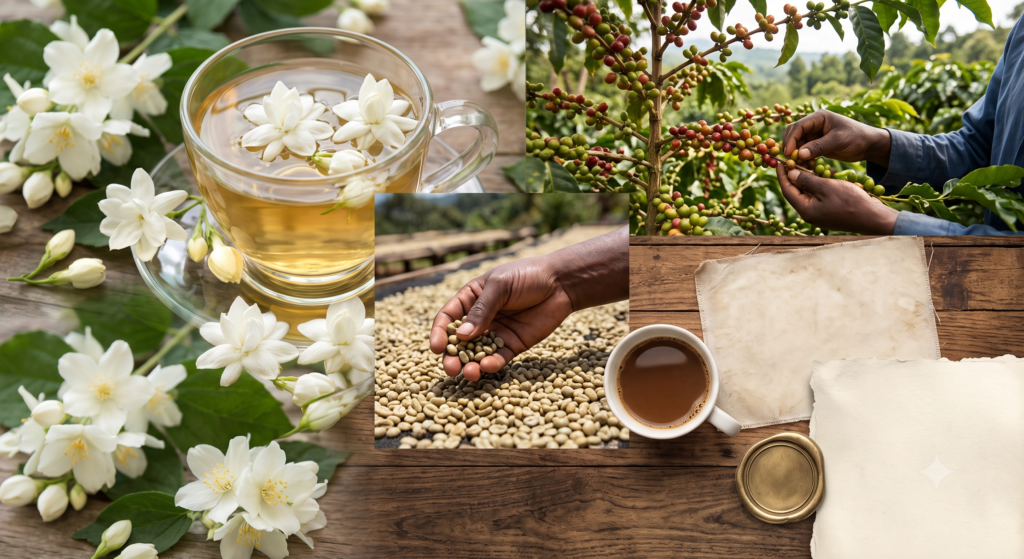
The science behind the jasmine aroma: how is this even possible?
This is the part most coffee drinkers don’t know and once you do, you’ll never look at a cup of coffee the same way again.
Yirgacheffe’s jasmine aroma comes from two main chemical compounds: linalool and geraniol the very same molecules responsible for the scent of real jasmine, roses, and lavender in nature. They aren’t added from the outside they form naturally during fermentation, when the beans are processed using the washed method.
Here’s how it works: after harvesting, the outer skin of the cherry is removed and the beans are soaked in water tanks. In that anaerobic environment, natural bacteria and yeast begin breaking down the mucilage clinging to the bean. Over the course of 24–72 hours of fermentation, a series of complex biochemical reactions take place and linalool and geraniol are among the most valuable “byproducts” of that process.
Three highly sensitive factors decide whether linalool appears
Whether linalool appears at all, and how strongly, depends on three extremely sensitive factors:
- Fermentation temperature — too hot (above 25°C) or too cold (below 15°C) both disrupt the microbial community and suppress linalool production. Yirgacheffe happens to sit at a naturally stable, ideal range of 18–22°C.
- Water source — minerals in the fermentation water directly affect the microbial ecosystem. Water from the natural streams flowing through the Gedeo highlands carries a distinctive mineral composition that can’t be replicated elsewhere.
- Fermentation time — too short, and linalool hasn’t fully formed; too long, and the flavor shifts toward sharp sourness and over-fermentation. Yirgacheffe’s farmers have accumulated generations of experience in timing this precisely.
And finally, one more factor that matters just as much: during roasting, if the temperature is kept at a light roast level (bean temperature around 195–205°C), linalool and geraniol are preserved. Roast any darker, and they disappear entirely. That’s why Yirgacheffe is always roasted light to medium never dark.
Natural vs. washed Yirgacheffe, two different worlds from the same land
One of the most fascinating things about Yirgacheffe is that the exact same land, the exact same variety, can produce two experiences that feel like they came from two different countries — simply by changing the post-harvest processing method.
Washed Yirgacheffe: This is the “classic,” most famous version of Yirgacheffe. The skin is removed and the beans ferment in water before drying a process that produces a clean, clear, focused flavor. Jasmine stands out the most here, alongside lemon, green tea, and bergamot. The acidity is bright and crisp, the body light as silk. This is the cup that leaves first-time drinkers stunned, because it’s unlike anything they’ve had before.
Natural Yirgacheffe: The cherries are dried whole, skin on, in the sun for several weeks, letting the fruit flesh ferment naturally around the bean. The result is an entirely different Yirgacheffe: blueberry, strawberry, red grape, and sometimes even a hint of red wine bold, complex, and almost addictive in its own way. Less floral than washed, but with far more sweetness and fruity notes to make up for it.
Neither version is “better” they simply suit different moments and different moods. But if this is your first time hearing about Yirgacheffe and you want to experience that legendary jasmine note, start with washed that’s where the story is told most clearly.
How to properly brew Yirgacheffe so you don’t miss a thing
Now that you know the story behind Yirgacheffe, the last thing you want is to accidentally ruin the experience with the wrong brewing habits. Here are the simple principles for enjoying it properly:
Water temperature
84–86°C, never boiling no exceptions. At 100°C, linalool evaporates almost instantly on contact with water. At 84–86°C, it dissolves gradually into the water and stays in the cup. Tip: boil the water, turn off the heat, and wait exactly 3 minutes.
No sugar
At least the first time. Sugar doesn’t just sweeten the coffee, it occupies your taste receptors and masks nearly all of the delicate floral notes. Try it black once. If you still want to add sugar afterward, that’s entirely your choice but at least you’ll know what the coffee actually tastes like.
Smell before you drink
This is half the experience. Yirgacheffe’s aroma is often stronger than its taste. As steam rises from the cup, bring your nose close and take a long inhale jasmine, bergamot, and sometimes green tea blossom will reveal themselves one by one. Skip this step, and you’re missing 40–50% of the full experience.
Use a white porcelain cup with a wide mouth
A wide rim helps concentrate the aroma toward your nose more effectively. A white cup doesn’t distort your perception of color and the coffee’s color affects how you perceive its taste more than you might think, according to numerous studies in taste psychology.
Yirgacheffe and freeze-drying technology, why this is a match made for each other
This is where art and science meet in the most remarkable way in modern coffee.
The core challenge with Yirgacheffe — and with any floral Arabica is that linalool and geraniol are extremely volatile. At room temperature, they’re already slowly escaping. At 100°C, they vanish within seconds. And in traditional industrial spray-drying, which uses temperatures of 150–200°C to produce instant coffee powder? They simply don’t survive long enough for you to taste them.
That’s why, for decades, specialty coffee experts have treated turning Yirgacheffe into instant coffee as something close to sacrilege doing so would be like buying a Picasso painting and burning it, just to keep the ashes in a box.
Freeze-drying technology changes all of that.
By freezing already-brewed coffee down to minus 40°C and using a vacuum chamber to sublimate the water directly from ice to vapor skipping the liquid phase entirely and never applying any high heat linalool and geraniol get “frozen” intact within every particle of powder. They sit there, dormant, waiting, until you dissolve the coffee in hot water and at that moment, they’re released and rise straight to your nose, as intact as the day Yirgacheffe’s farmers picked the cherries.
This is why serious specialty coffee brands around the world, when they want to make an instant single-origin coffee from Yirgacheffe or any other floral region, only ever choose freeze-drying there’s no second option.
Yirgacheffe and K7 Caphe, the same philosophy, two different lands
K7 CAPHE does not use Yirgacheffe Arabica in its products we source Arabica from Vietnam’s own land: Cầu Đất (Lâm Đồng) and Khe Sanh (Quảng Trị). But the philosophy is the same: the finest flavors deserve to be preserved the right way, and freeze-drying is the only guardian capable enough to do it.
K7 CAPHE’s Vietnamese Arabica doesn’t carry Yirgacheffe’s jasmine note it has its own language of almond, caramel, and subtle white flowers, spoken by the basalt soil of Cầu Đất and the humus-rich earth of Khe Sanh. Those flavors, different as they are from Yirgacheffe’s, deserve to be told and enjoyed the right way too not burned away by heat, not masked by artificial flavoring.
To understand Yirgacheffe is to understand why freeze-drying matters. And to understand why freeze-drying matters is to understand why K7 CAPHE exists.

Frequently asked questions
What is Yirgacheffe? Yirgacheffe is a town and renowned coffee-growing region in southern Ethiopia, in the Gedeo zone, protected by an official Geographic Indication and regarded as one of the most prestigious Arabica regions in the world.
Why does Yirgacheffe coffee smell like jasmine? Because of two compounds, linalool and geraniol, which form naturally during washed fermentation, amplified by the distinctive climate, altitude, and water source of the Gedeo region.
What water temperature should I use to brew Yirgacheffe? The ideal temperature is 84–86°C. Avoid boiling water at 100°C, as it causes linalool to evaporate almost instantly, stripping the coffee of its signature floral aroma.
How is washed Yirgacheffe different from natural Yirgacheffe? Washed produces a clean flavor with pronounced jasmine notes and bright acidity. Natural produces a sweeter, fruitier cup think blueberry and strawberry with less floral character but more complexity and depth.
Why does instant coffee usually lose its floral aroma? Because traditional spray-drying uses temperatures of 150–200°C, which completely destroys volatile floral compounds like linalool and geraniol before the final product is even made. Only freeze-drying which uses no heat can preserve them.
Experience true freeze-dried coffee today
You now know the story behind that legendary jasmine aroma. It’s time to experience freeze-drying technology, the only method that fully preserves the essence of the bean right in your own cup of K7 CAPHE.
K7 CAPHE freeze-dried coffee — Vietnamese Arabica from Cầu Đất & Khe Sanh, blended with Đắk Lắk Robusta, no additives, no flavoring. Authentic flavor in every compact stick.
Domestic customers: Order now via our website or e-commerce platform: Buy now — K7 CAPHE on Shopee
International customers: Please reach out to us directly: Contact K7 CAPHE
