




If you’ve ever wondered why two bags of coffee both labeled “100% Arabica” can taste completely different the answer isn’t the brand, and it isn’t the roasting method. It’s something that can’t be faked: the land where those beans were grown.
Why does the same arabica taste so different from region to region?
In the world of wine, nobody is surprised to hear that a bottle of Pinot Noir from Burgundy and one from Oregon taste completely different even though they’re the same grape variety. That’s because wine lovers are already familiar with the concept of terroir: the combination of soil, water, climate, and human hands that gives each growing region its own character.
Modern specialty coffee takes that philosophy seriously and the result is a global “flavor map” that every coffee lover deserves to know.
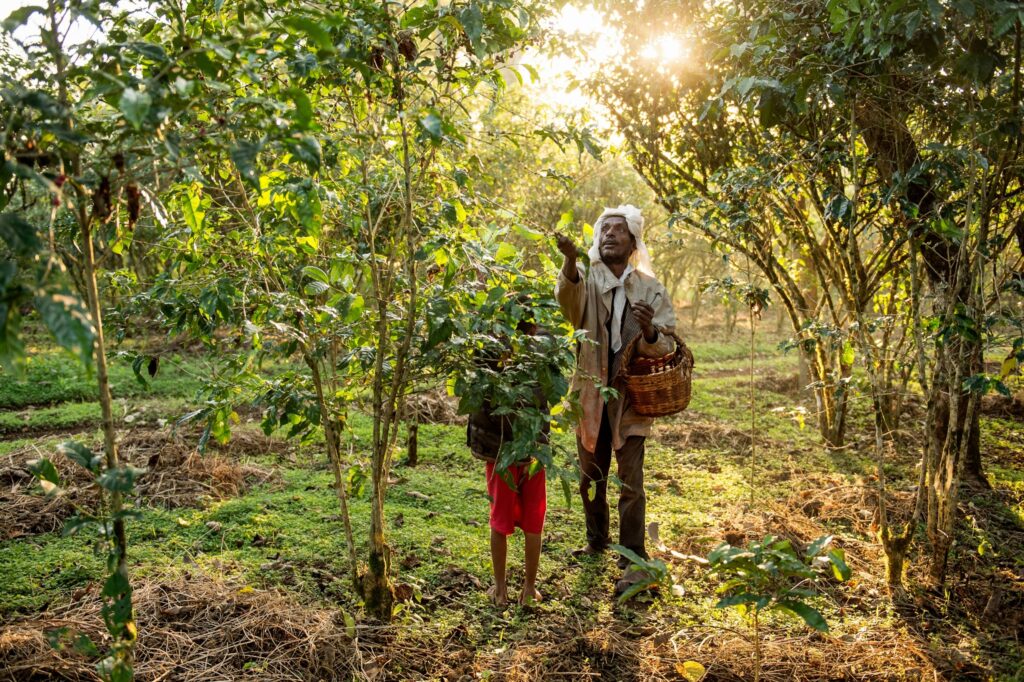
Three factors decide the flavor of any Arabica:
- Altitude is the most important factor. For every 100 meters of elevation, temperature drops by about 0.6°C making the cherries ripen more slowly and accumulate more natural sugars and complex organic acids. Arabica grown at 2,000 meters will have a far more refined, complex flavor than the same variety grown at 800 meters.
- Climate and soil decide the “language” the land uses to speak to the coffee tree how much rain falls, whether the soil is basalt or humus, how wide the day-night temperature swing is. All of it gets stamped into every bean in a way that can’t be replicated.
- Post-harvest processing — natural, washed, or honey can change up to 30–40% of the final flavor of the exact same batch of beans. This is the final “brushstroke” farmers and processing experts use to complete the flavor picture.
With these three factors in mind, let’s take a tour around the world coffee map.
Ethiopia, the birthplace of coffee, and a land of surprises
There’s no better place on earth to start this journey.
Ethiopia isn’t just a place where Arabica is grown it’s where the species was born, naturally, in the forest. Wild coffee trees in the Kaffa and Bale regions still grow freely today, the ancestors of nearly every cup of coffee you’ve ever had.
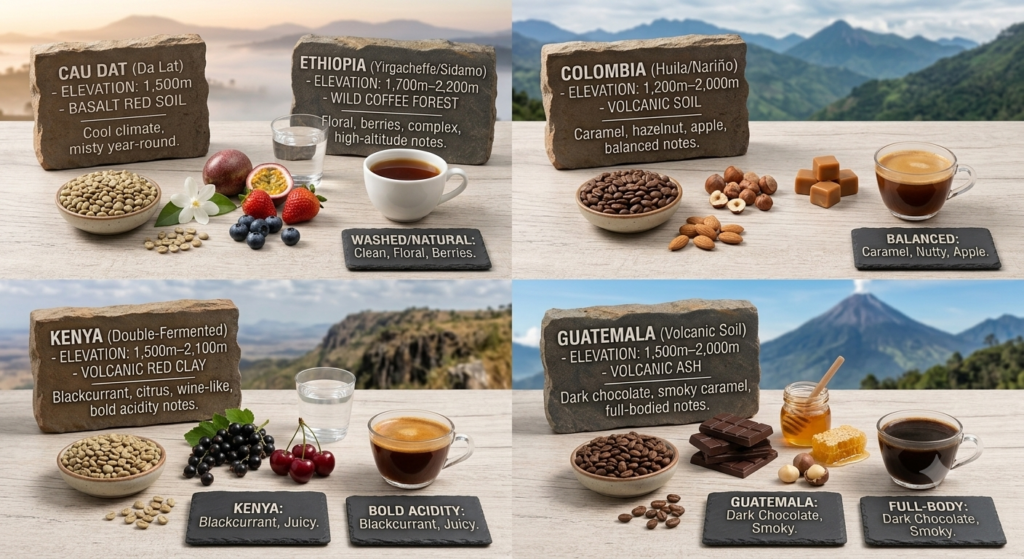
The flavor of Ethiopian Arabica especially from Yirgacheffe, Sidamo, and Harrar often catches first-time drinkers off guard: “Did someone put jasmine in this cup?” The answer is no. It’s linalool and geraniol, compounds that form naturally during fermentation, amplified by the 1,700–2,200 meter altitude and a stable, year-round climate.
Flavor portrait of Ethiopia:
- Aroma: Jasmine, bergamot, floral tea — intense and instantly recognizable
- Taste: Passion fruit, blueberry, strawberry — bright, vivid, and layered
- Body: Light to medium, silky smooth — never heavy, very easy to drink
- Acidity: High but refined, like a sweet lemon rather than a sharp sour one
- Finish: Long, fruity, leaves a fresh feeling
Ethiopia is the perfect choice for anyone who wants to explore coffee in its most refined, artistic form. Drink it black, brewed pour-over or freeze-dried and be ready for a surprise.
Colombia, coffee of perfect balance
If Ethiopia is a free-spirited, unpredictable artist, Colombia is a classical musician no note out of place, nothing missing, everything exactly where it should be.
Sitting between two branches of the Andes at 1,200–2,000 meters, Colombia has a rare geographic advantage: year-round harvest thanks to two rainy seasons, stable temperatures, and diverse microclimates that give each growing region its own nuance. Huila and Nariño are the two most highly regarded regions, regularly scoring above 85 on the Q score.
Flavor portrait of Colombia:
- Aroma: Caramel, hazelnut, orange — warm, familiar, and pleasant from the first sniff
- Taste: Red apple, apricot, light milk chocolate — naturally sweet and balanced
- Body: Medium, smooth — not as light as Ethiopia, not as heavy as Brazil
- Acidity: Gentle and pleasant — never sharp, never overwhelming for beginners
- Finish: Sweet caramel, moderately long
Colombia is the reason so many people fall in love with specialty coffee the very first time they try it: complex enough to be interesting, yet friendly enough to never feel intimidating. It works with nearly every brewing method pour-over, French press, freeze-dried, even Vietnamese phin.
Kenya, coffee for the true connoisseur
If you want to challenge your palate and explore the most complex corners of coffee, Kenya is the next destination.
Kenyan Arabica is famous for an acidity so sharp it’s almost “bold” not an unpleasant sourness, but a lively, juicy acidity, close to biting into a ripe black grape. This comes from two factors: phosphorus-rich volcanic red soil on the Kenyan highlands, and a unique double-fermentation wash process found only in this country the beans ferment twice in clean water, producing a sharp, clean acidity found nowhere else.
Flavor portrait of Kenya:
- Aroma: Black grape, blackcurrant, intense citrus — bold and immediately striking
- Taste: Ripe tomato, plum, berries — complex, layered, sometimes unexpected
- Body: Full and juicy — rich, yet still bright
- Acidity: High and sharp — this is Kenya’s “signature,” love it or hate it
- Finish: Long, deeply fruity, occasionally with a wine-like hint
Kenya isn’t for everyone and that’s exactly what makes it special. If you’ve already grown familiar with Ethiopia and Colombia and want to level up your experience, Kenya is the next worthy challenge.
Guatemala, mystery among volcanoes and fog
At the end of this journey is a region rarely mentioned in Vietnam’s coffee community but held in very high regard by coffee experts worldwide: Guatemala.
Located in Central America, home to more than 30 active volcanoes, Guatemala has volcanic soil extraordinarily rich in minerals and a distinctive microbial ecosystem. Its two most famous growing regions Antigua (a valley nestled between three volcanoes) and Huehuetenango (near the Mexican border, at elevations up to 2,000 meters) produce flavor profiles unlike anywhere else in the coffee world.
Flavor portrait of Guatemala:
- Aroma: Dark chocolate, lightly smoky caramel, dried plum — deep and mysterious
- Taste: Rich dark chocolate, brown sugar, macadamia nut — bold and warm
- Body: Heavy and full — feels like you’re drinking something with real substance
- Acidity: Low to medium — not sharp like Kenya, very gentle on the stomach
- Finish: Long, lightly smoky, chocolatey — especially well-suited to dark roast lovers
Guatemala is the perfect choice for anyone who loves a bold espresso, or wants to drink coffee with milk while still tasting its signature character Guatemala’s chocolate notes still come through even when mixed with milk.
Where does Vietnamese arabica sit on this map?
After touring four of the world’s coffee “landmarks,” a natural question comes up: where does Vietnamese Arabica sit on this global flavor map?
The answer: right between Colombia and Guatemala in character, but with a signature entirely its own thanks to the unique terroir of two highland regions, Cầu Đất (Lâm Đồng) and Khe Sanh (Quảng Trị).
Flavor portrait of Vietnamese arabica (Cầu Đất & Khe Sanh):
- Aroma: Subtle white flowers, roasted almond, a light hint of citrus — warmer than Ethiopia, more refined than Guatemala
- Taste: Sweet golden apple, caramel, light chocolate (more pronounced in Khe Sanh) — natural sweetness from slow ripening on the highlands
- Body: Medium to full — fuller than Colombia, lighter than Guatemala
- Acidity: Low to medium, gentle and pleasant — closer to Colombia than to Kenya or Ethiopia
- Finish: Nutty, caramel, no bitterness — lasting 30–60 seconds
If Ethiopia is the free-spirited artist and Kenya is the connoisseur’s challenge, Vietnamese Arabica shares Colombia’s approachability but carries a chocolate and nutty depth closer to Guatemala. That’s a unique spot on the global flavor map: complex enough to be interesting, balanced enough to drink every day.
This is also why Cầu Đất Arabica has scored 83–86 on the Q scale a score that places Vietnamese coffee on the world’s specialty map, even though it remains far less known than the four regions above.
When freeze-drying meets the global flavor map
Now that you understand the global flavor map, a natural question follows: which processing method best preserves those terroir characteristics?
The answer won’t surprise anyone who follows the specialty coffee world: freeze-drying is currently the only method that can carry each region’s signature into a convenient instant product without losing its soul.
Traditional roasting and industrial spray-drying both use heat and heat is the enemy of the most delicate flavor compounds. Ethiopia’s linalool, Colombia’s malic acid, and Kenya’s complex aldehydes all break down above 120°C. Freeze-drying operates at minus 40°C no heat, no lost aroma, no loss of the “soul” of the land that produced the bean.
This is also why K7 CAPHE built its foundation on both freeze-drying technology and high-quality Vietnamese Arabica from Cầu Đất and Khe Sanh. We don’t need to go looking for Ethiopia or Colombia Vietnam has its own land, its own flavor, and its own story worth preserving the right way.
Every K7 CAPHE stick isn’t just a convenient coffee packet it’s a “flavor postcard” from the Vietnamese highlands, packaged with 21st-century technology to preserve the spirit of these special regions.
Discover Vietnamese arabica’s flavor today
You now know Ethiopia brings jasmine, Colombia brings caramel, Kenya brings black grape, and Guatemala brings smoky chocolate. Vietnamese Arabica — from Cầu Đất and Khe Sanh is waiting for you to discover its flavor for yourself.
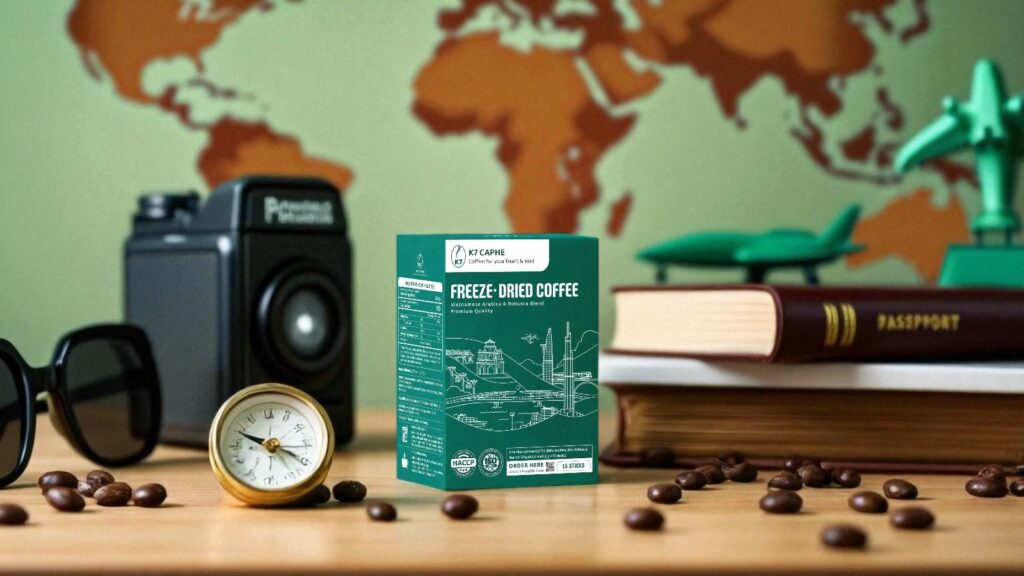
K7 CAPHE freeze-dried coffee — high-quality Vietnamese Arabica, blended with Đắk Lắk Robusta, preserved note by note through freeze-drying technology. No additives, no artificial flavoring.
Domestic customers: Order now via our website or e-commerce platform: Buy now — K7 CAPHE on Shopee
International customers: Please reach out to us directly: Contact K7 CAPHE
