




The first time most people drink coffee without sugar, they wince. Too bitter. Something’s missing. It just doesn’t feel right. But then there’s a group of people who after a few weeks of sticking with it suddenly “switch on” and start noticing things they’d never picked up on before: natural sweetness, a faint caramel note, an almond finish that lingers… And from that point on, they can’t go back to sweetened coffee. What actually happened? And can you get there too?
The science of taste and sugar: why sugar sabotages flavor
Before talking about how to “retrain” your palate, it helps to understand exactly what happens in your brain and on your tongue when you add sugar to coffee.
The moment sugar touches your tongue, it fires the sweet-taste receptors (T1R2-T1R3) with very high intensity strong enough to override the other flavor signals competing alongside it. This is called “taste masking”: one powerful taste drowning out the more subtle ones around it.
Picture it this way: you’re trying to listen to a soft, gentle voice at a small concert and someone turns on a portable speaker right next to your ear. The voice is still there, but you simply can’t hear it anymore. Sugar in coffee works exactly like that speaker it doesn’t erase Arabica’s flavor, but it “drowns it out” until your brain no longer registers it.
That’s just the short-term problem. The long-term one is more serious.
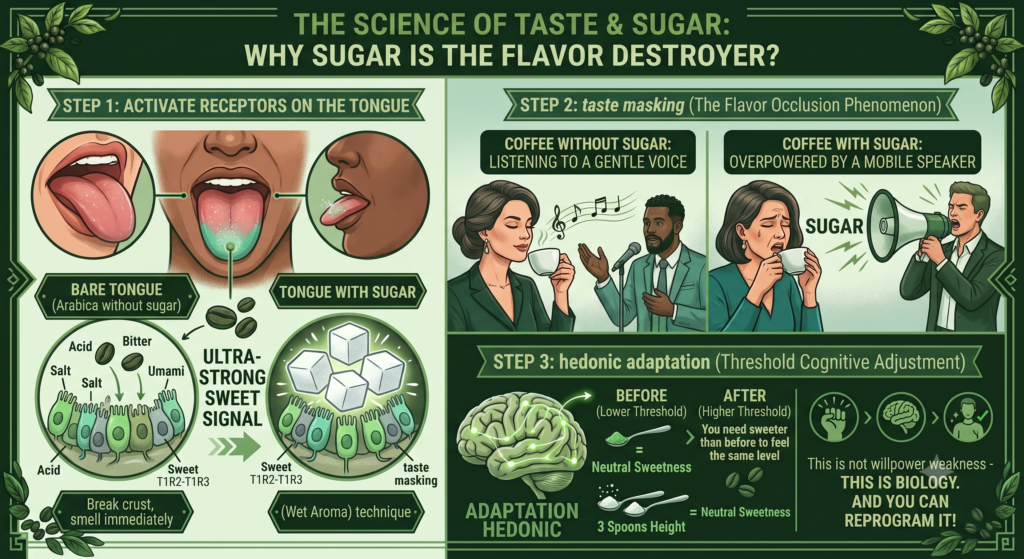
When you drink sweetened coffee every day, your brain gradually raises the threshold at which it registers sweetness a neurological mechanism called “hedonic adaptation.” In plain terms: you need more sugar to feel the same level of sweetness. Two spoonfuls becomes the new normal, then three, and eventually you realize you’re drinking something closer to syrup water than coffee, without quite knowing how you got there.
This isn’t a lack of willpower it’s biology. And the good news is: biology can be retrained.
Sugar-free Arabica: the flavor layers you’re missing every day
High-quality Arabica beans naturally contain 6–9% sucrose by weight noticeably higher than Robusta (only 3–7%). During roasting, this sucrose undergoes the Maillard reaction and caramelization, generating hundreds of new compounds with notes of caramel, roasted almond, toffee, and brown sugar all of them “natural sugar” that comes from the bean itself.
This sweetness isn’t loud the way added sugar is. It shows up at the end after you swallow, once the bitterness and acidity have faded, Arabica’s natural sweetness lingers as a gentle, pleasant aftertaste, like biting into a freshly roasted chestnut.
If you’re adding sugar, you’ll never “hear” that quiet voice.
Beyond natural sweetness, drinking black also opens up:
- More complex acidity — the bright notes of malic acid (apple), citric acid (orange), or tartaric acid (grape) subtle layers that disappear entirely once sugar is added. This is exactly why coffee professionals always cup without sugar: they need to hear the full “orchestra,” not just one instrument.
- Fuller aroma — when your mouth isn’t dominated by sweetness, your sense of smell works better, and you pick up more notes in every sip. People new to black coffee are often surprised that “the coffee suddenly smells stronger”, it isn’t actually stronger, you’re just smelling it properly for the first time.
- Real health benefits — no empty calories from sugar, no blood-sugar spike, no sugar crash roughly 90 minutes later. For anyone watching their weight or managing blood sugar, that difference adds up meaningfully across 365 days a year.
The 21-day “sugar detox” plan: no pain, no iron willpower required
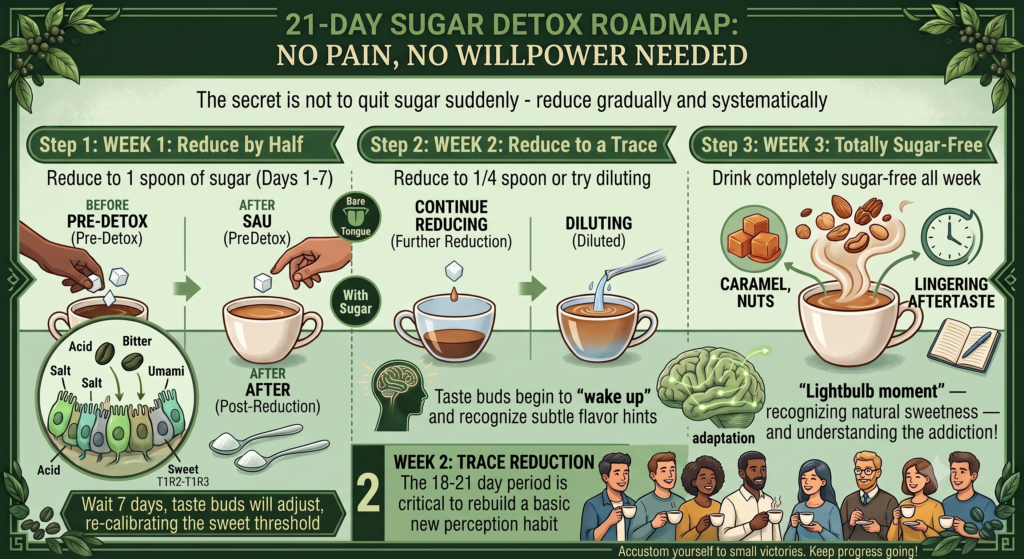
The trick is not to quit sugar cold turkey your brain will react as if something important is missing, and that discomfort will make you give up by day three. Instead, cut back gradually and systematically.
Week 1 — Cut it in half
If you’re currently using 2 spoonfuls of sugar, cut down to 1. Hold at this level for 7 days so your palate can adjust. You may feel like your coffee is “missing something” for the first 2–3 days that’s normal; it’s your brain recalibrating its sweetness threshold. After 5–7 days, 1 spoonful will start to taste sweet enough.
Week 2 — Cut it down to a trace
Reduce from 1 spoonful to 1/4 spoonful or try going fully sugar-free but brewing it slightly weaker (a 1:18 ratio instead of 1:15). This is the most important week: your palate starts to “wake up,” and you’ll begin noticing things that were masked before. Write down what you start to notice smell? taste? aftertaste?
Week 3 — Fully sugar-free
Drink it completely black for the whole week. This is the week many people describe as their “lightbulb moment” one day you take a sip and suddenly, clearly taste the natural caramel sweetness, the almond notes, the lingering finish… and you understand why some people get hooked on black coffee.
The 21-day window isn’t an arbitrary number neuroscientists estimate it takes roughly 18–21 days for the brain to restructure a new sensory habit at a basic level. You don’t need to be perfect if you slip and add a bit of sugar one day during week 2, that’s fine. Just get back on the plan and keep going.
4 tips to make black coffee easier to drink when you’re starting out
| Tip | How to do it |
|---|---|
| Lower the water temperature slightly | Bitterness is perceived more strongly at higher temperatures. If you’re brewing K7 CAPHE at 85°C and find it unpleasantly bitter without sugar, try dropping to 80–82°C bitterness drops noticeably while the natural sweetness stays largely intact. |
| Brew it weaker at first | A 1g coffee : 18ml water ratio (instead of the standard 1:15) produces a gentler, less bitter cup that’s easier on a palate still adjusting. After 2–3 weeks, gradually move up to 1:16, then 1:15 once you’ve adapted. |
| Pair it with a square of 70–85% dark chocolate | Dark chocolate fires the sweet and bitter receptors at the same time, “familiarizing” your palate with a bitter-sweet combination that doesn’t rely on sugar. Dark chocolate’s flavor and Arabica’s caramel notes also complement each other well a more interesting experience than either on its own. |
| Use a small cup and sip slowly | When you drink fast and in large amounts, your brain processes the flavor as one blur without time to analyze it. Sipping slowly, with a few seconds between sips, gives your brain time to pick up the more subtle flavor layers. |
How do you know you’ve finished “training” your palate?
There’s no single day you “graduate” to a sugar-free palate but there are four clear signs your taste has genuinely shifted:
| Sign | What it looks like |
|---|---|
| 1 — Sweetened coffee suddenly feels too heavy | You try a sweetened cup again — and it feels overwhelming, drowning out everything else, to the point you can’t tell you’re drinking Arabica or anything besides sweetness. |
| 2 — You can tell different acidities apart | You start distinguishing pleasant acidity (apple, orange) from harsh acidity (unpleasant sourness from poor brewing or low-quality beans). |
| 3 — You start paying attention to aftertaste | You begin judging coffee partly by how long the aftertaste lingers and how pleasant it is. A short, bitter finish is a bad sign; a long, caramel or nutty finish signals quality. |
| 4 — Black coffee feels complete on its own | You drink K7 CAPHE without sugar and feel satisfied — nothing missing, nothing to add. The natural sweetness of Cầu Đất and Khe Sanh Arabica satisfies you in a way sugar never could, sustainably. |
Frequently asked questions about drinking coffee without sugar
Why does sugar mask coffee’s flavor? Sugar fires the sweet-taste receptors with very high intensity, overriding the other, more subtle flavor signals competing alongside it — a phenomenon called “taste masking.” Arabica’s bright acidity, aroma, and aftertaste are still there; your brain just stops registering them.
How long does it take to quit sugar in coffee? About 21 days, split into three weeks: cutting the amount in half, reducing it to a trace, then going fully sugar-free. Neuroscientists estimate this is roughly the time it takes the brain to restructure a new sensory habit.
Do I need to quit sugar cold turkey? No — that’s not recommended. Quitting abruptly makes the brain react as if something important is missing, which tends to cause discomfort and early quitting. Cutting back gradually over the 3-week plan is far more effective and easier to stick with.
What are the health benefits of drinking coffee without sugar? No empty calories from sugar, no blood-sugar spike, and no sugar crash roughly 90 minutes later — a meaningful difference when multiplied across 365 days a year.
How can I make black coffee less bitter when I’m just starting out? Lower the brew temperature to 80–82°C, brew it weaker (a 1:18 ratio instead of 1:15), pair it with a square of 70–85% dark chocolate, and sip slowly in small amounts (see the tips table above).
What signs show I’ve adjusted to drinking coffee without sugar? The four clearest signs: sweetened coffee suddenly feels too heavy, you can tell different types of acidity apart, you start noticing aftertaste, and black K7 CAPHE feels complete without needing anything added.
K7 CAPHE cold-dried Arabica — naturally sweet from Cầu Đất & Khe Sanh Arabica, bold from Đắk Lắk Robusta, no additives, no added sugar base. Brew with 83°C water, no sugar, small and slow sips, today’s a good day to start.
Domestic customers: Buy now on our website or on e-commerce platforms: Buy now — Shopee K7 CAPHE
International customers: Please contact us for assistance: Contact K7 CAPHE
