




Two cups of coffee, both labeled “Arabica” one smells of delicate jasmine, the other tastes of sweet caramel and feels velvety smooth. If you’ve ever wondered why Vietnamese Arabica and Ethiopian Arabica create such different experiences despite coming from the same variety, the answer lies in a concept winemakers have understood for centuries.
What is terroir, and why does it decide everything?
In the world of wine, nobody questions why Bordeaux and Burgundy taste completely different even though both are French reds. The answer is always one word: terroir, a concept covering the entire natural environment where a crop is grown, including soil, water, climate, altitude, and even the hands of the farmer who tends it.
Specialty coffee today follows that exact same philosophy.
When you buy a bag labeled “Ethiopian Arabica” and one labeled “Vietnamese Arabica,” biologically they come from the same species: Coffea arabica. But that’s where the similarity ends. It’s a bit like twins raised in two different countries same genes, but completely different personalities, languages, and ways of seeing the world.
Terroir in coffee isn’t marketing. It’s real science, and understanding it will completely change how you choose and enjoy coffee.
Ethiopian Arabica — the “ancestor” of every cup of coffee in the world
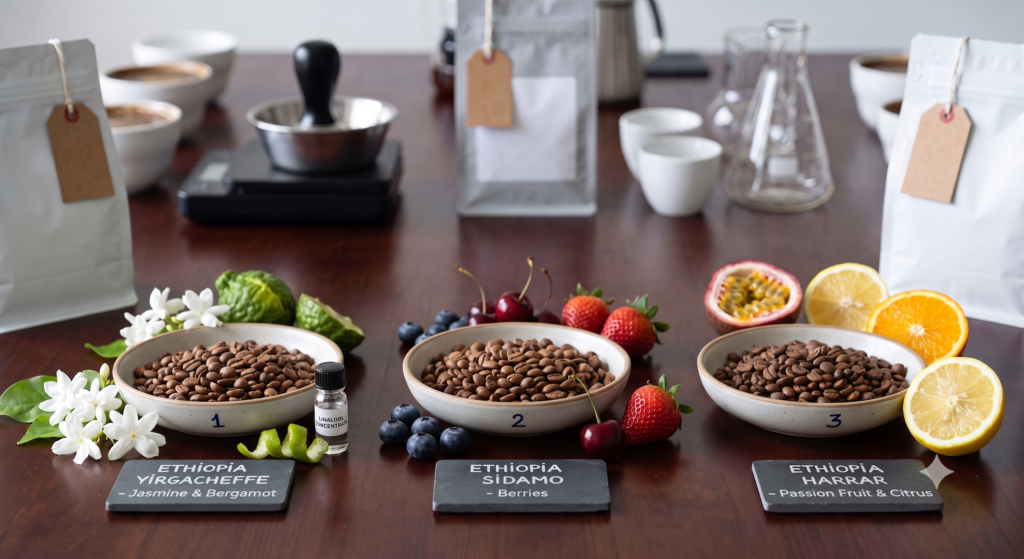
Ethiopia isn’t just a place where Arabica is grown, it’s where Arabica was born. The world’s first wild coffee trees grew naturally in the tropical forests of the Kaffa and Bale highlands, at elevations of 1,700–2,200 meters above sea level.
Ethiopia’s natural conditions create an environment no other place on earth can fully replicate. A cool climate year-round, evenly distributed rainfall, and a day-night temperature swing of 15–20°C make the coffee cherries ripen extremely slowly. Slow ripening means more natural sugars and flavor compounds accumulate this is the secret behind Ethiopian coffee’s signature flavor complexity.
Typical flavors of Ethiopian Arabica include:
- Jasmine and bergamot — especially pronounced in the Yirgacheffe region, produced by the compound linalool during fermentation
- Red berry fruit like blueberry, cherry, and strawberry characteristic of the natural process (sun-drying whole cherries)
- Passion fruit and citrus — clearly present in washed processing
- Light to medium body, with a silky-smooth feel on the tongue
Ethiopia’s three most famous regions Yirgacheffe, Sidamo, and Harrar each produce their own distinct flavor profile, distinct enough that a Q-Grader can identify them by aroma alone, before even tasting.
Vietnamese Arabica — Cầu Đất, Khe Sanh, and Sơn La
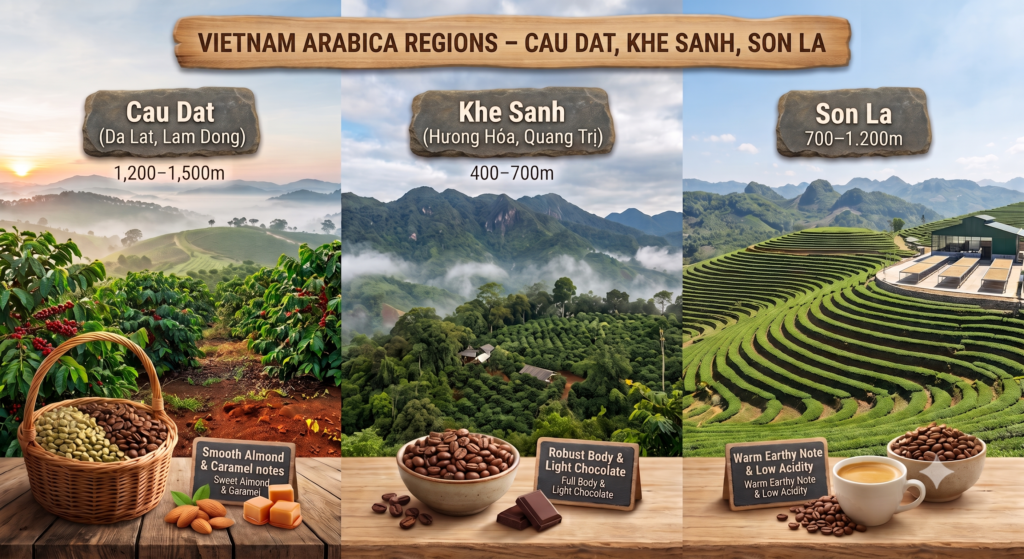
Few people know that Vietnam also grows high-quality Arabica and it’s increasingly catching the attention of the international specialty coffee community. Vietnamese Arabica spans three main growing regions, each with its own distinct character.
Cầu Đất (Đà Lạt, Lâm Đồng)
At an elevation of 1,200–1,500 meters, this is Vietnam’s oldest Arabica-growing region, first planted by the French in the late 19th century. Volcanic red basalt soil, year-round fog, and a wide day-night temperature swing produce naturally sweet beans with notes of almond and mellow caramel. Cầu Đất is gradually earning specialty-grade recognition, with Q scores reaching 83–86 points a figure Vietnamese coffee can be proud of.
Khe Sanh (Hướng Hóa, Quảng Trị)
A lesser-known Arabica region, but one with a history and quality that are no less remarkable. Located in the Trường Sơn mountain range at 400–700 meters, Khe Sanh has the cool climate typical of central Vietnam a long rainy season and dense fog producing Arabica beans with a full body, light chocolate notes, and low acidity that’s easy to drink. Local farmers have grown Arabica here since the French colonial era, and Khe Sanh is now gradually being recognized by domestic coffee experts as a promising source region.
Sơn La
In northern Vietnam, at 700–1,200 meters, Sơn La is the country’s largest Arabica-growing region by land area, and is being heavily invested in for specialty-grade production with support from several international projects.
What all three regions share: basalt or red soil rich in phosphorus and potassium, creating ideal conditions for Arabica to thrive.
But Vietnam’s terroir differs from Ethiopia’s in fundamental ways a tropical monsoon climate, higher temperatures, and a more pronounced dry season. This creates a completely different flavor profile: not light and floral like Ethiopia, but full-bodied, warm, and more approachable.
Typical flavors of Vietnamese Arabica:
- Roasted almond and mild caramel — characteristic of mineral-rich basalt soil
- Light chocolate and warm earthy notes — more pronounced in Khe Sanh and Sơn La
- Medium to full body — heavier than Ethiopian Arabica, giving a fuller mouthfeel
- Low to medium acidity — gentle and easy to drink, especially for those unused to bright acidity
What happens when Arabica meets freeze-drying technology?
This is the most interesting part — and the reason terroir matters more than ever in the world of freeze-dried coffee.
When roasted and processed at high heat, most of the flavor compounds unique to each growing region get altered or destroyed. A dark-roast Ethiopian cup and a dark-roast Vietnamese cup can end up tasting quite similar bitter, smoky, with most of that regional “character” gone.
Freeze-drying changes that completely.
Because no heat is used during the powder-forming process, freeze-drying preserves the terroir signature in every flavor molecule. Yirgacheffe’s linalool is still there. Cầu Đất’s almond-caramel notes remain intact. When you dissolve freeze-dried coffee in water, you’re reviving exactly what that specific patch of land produced.
But this also means freeze-drying can’t hide poor-quality beans. If the original coffee isn’t good, freeze-drying preserves that flaw just as faithfully. That’s why serious freeze-dried coffee brands have to invest in high-quality sourcing from the very start there’s nowhere to hide.
K7 Caphe — Arabica sourced from Vietnamese soil
K7 Caphe uses Arabica from Vietnam’s highlands, blended with Robusta from Đắk Lắk a deliberately designed combination.
Arabica brings delicate aroma, natural sweetness, and flavor complexity. Central Highlands Robusta acts as the “backbone,” providing a full body, thick crema, and a balanced bitter edge.
And the entire blend is preserved through freeze-drying technology so the terroir signature of Vietnamese soil reaches you intact, whether you’re brewing coffee at an office in Hanoi, in a hotel room in Singapore, or on an overnight train.
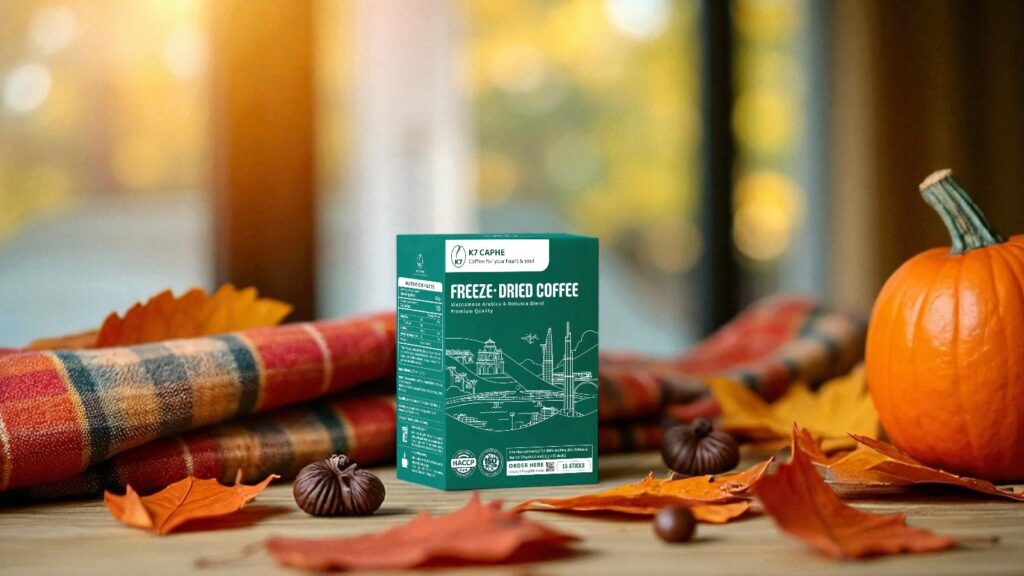
Ready to upgrade your coffee experience?
Discover the K7 CAPHE functional freeze-dried coffee range no additives, no artificial flavourings, certified HACCP & ISO 22000.
Domestic customers: Order now via our website or e-commerce platform: Buy now — K7 CAPHE on Shopee
International customers: Please reach out to us directly: Contact K7 CAPHE
