




Since the 15th century, when coffee was first brewed in copper pots across the Arabian Peninsula, people have been adding ginger to it. Not for lack of other spices, but because centuries of observation taught them: the combination left drinkers feeling healthier, warmer in the stomach, and refreshed for longer. Modern science has since stepped in and confirmed that ancient wisdom with clear molecular mechanisms.
Qahwa, a 600-year coffee heritage recognized by UNESCO
Before coffee reached the rest of the world, it lived inside Arab rituals for centuries and its oldest form looks nothing like what you’re drinking today.
Qahwa (pronounced “ka-hwa”) in classical Arabic means “the thing that makes you not want to eat” an odd name, but remarkably accurate physiologically (both caffeine and the gingerol in ginger have a mild appetite-suppressing effect). Over time, “qahwa” became the general Arabic word for coffee but Qahwa in its traditional sense is an entirely distinct drink.
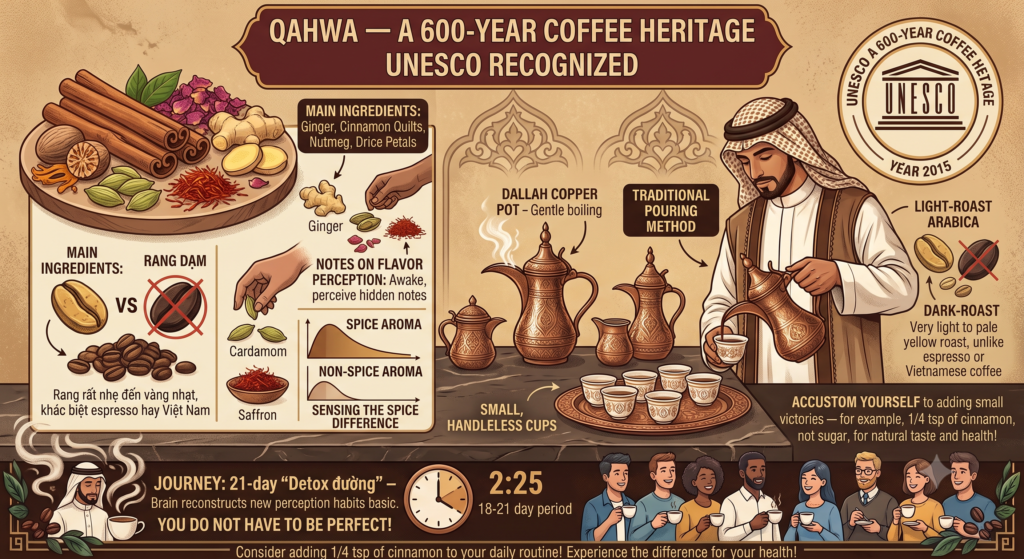
Traditional Qahwa coffee is brewed from very lightly roasted Arabica beans sometimes roasted only to a pale gold, nowhere near as dark as espresso or Vietnamese coffee together with four main spices: ginger, cardamom, saffron, and sometimes dried rose. This mixture is gently simmered in a copper pot called a dallah, then poured into small, handle-less cups.
Qahwa is never drunk with sugar not to save money, but because Arabs understood that sugar would mask the spices’ flavor and undercut ginger and cardamom’s digestive benefits. They were practicing “drinking it black” centuries before the term “specialty coffee” existed.
In 2015, UNESCO officially recognized Arab coffee culture including the ritual of brewing and serving Qahwa as part of the Intangible Cultural Heritage of Humanity. It was the first time a coffee-drinking culture was honored at that level internationally.
Gingerol, the compound that makes ginger “nature’s ibuprofen”
Ginger’s sharp scent and warm, spicy taste come from a group of compounds called gingerols mainly 6-gingerol, 8-gingerol, and 10-gingerol. These molecules don’t just create a sense of warmth; they also have significant biological activity that scientists continue to study in growing depth.
| Effect | Mechanism / evidence |
|---|---|
| Anti-inflammatory, similar to NSAIDs | Gingerol inhibits the COX-2 and LOX enzymes, two key players in the body’s inflammatory pathway, the same mechanism ibuprofen and aspirin use, but in a more natural way with fewer side effects at food-level doses. A meta-analysis in the Journal of Pain (2015), covering 593 patients, found ginger significantly reduced post-exercise muscle soreness compared to placebo. |
| Warming the stomach — not just a subjective feeling | Gingerol activates the TRPV1 heat receptor in the stomach and gut lining the same mechanism as capsaicin in chili peppers, but much gentler. Ginger also increases intestinal motility and stimulates digestive enzyme secretion, which explains why ginger coffee after a meal often reduces bloating and indigestion. |
| Reducing nausea | Ginger’s most-studied and best-evidenced effect. A review in Obstetrics & Gynecology (2014) concluded that ginger is effective and safe for treating pregnancy-related nausea; other studies show similar effects for chemotherapy-related, motion, and post-surgery nausea. |
| Improving blood circulation | Gingerol has a mild anti-platelet-aggregation effect, helping blood flow more freely this explains the “circulation boost” many people describe after ginger coffee. It’s also why caution is needed if you’re on blood-thinning medication (see the notes below). |
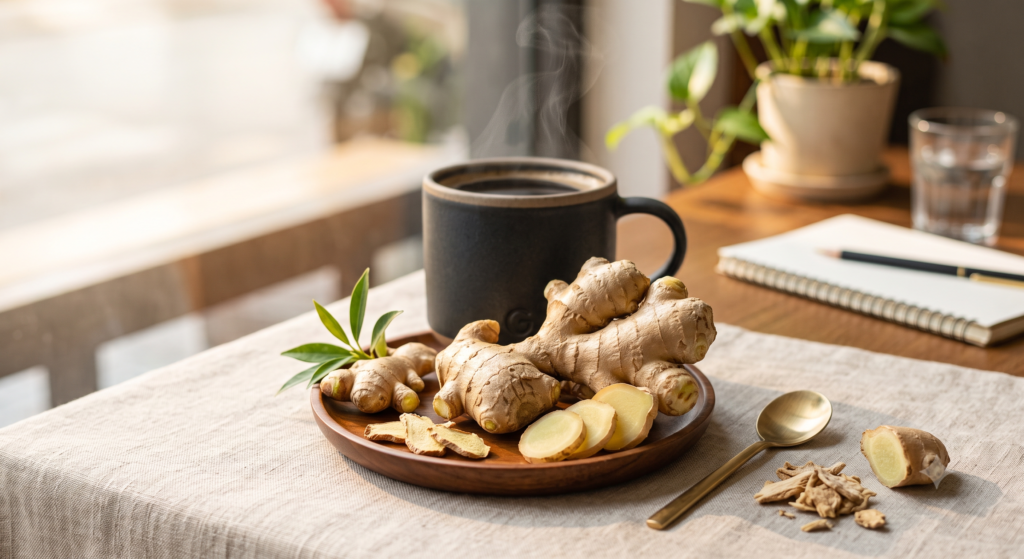
Why is cold-dried K7 CAPHE the best base for ginger coffee?
The coffee + ginger combination works best when the coffee base doesn’t interfere with ginger’s mechanisms and that’s where additive-free cold-dried coffee has a clear advantage.
- No competing additives — some instant coffees contain synthetic creamer, maltodextrin, or artificial flavorings. These not only add empty calories but can also dilute the effective gingerol concentration in the stomach and slow its absorption. K7 CAPHE is pure coffee with nothing added, so gingerol gets absorbed exactly as it’s meant to.
- Polyphenols work together — chlorogenic acid in cold-dried Arabica and gingerol in ginger both have antioxidant and anti-inflammatory effects through different pathways; combined, they complement rather than compete with each other. Some in-vitro studies show this combination has a synergistic effect on inhibiting NF-κB, a protein that coordinates the body’s inflammatory response.
- A compatible brewing temperature — K7 CAPHE is brewed at 83–85°C, which also happens to be the ideal temperature for extracting gingerol from fresh or powdered ginger without destroying its beneficial enzymes.
The “Ginger Coffee” recipe, from ancient Qahwa to a modern cup
The basic version, for first-timers
| Ingredient | Amount |
|---|---|
| K7 CAPHE cold-dried coffee | 1 stick |
| Water at 85°C | 150ml |
| Thinly sliced fresh ginger (2–3mm), or ground ginger | 1 slice, or 1/4 teaspoon |
Stir well and wait 1 minute for the fresh ginger to release its flavor, then drink right away. Flavor: warm coffee with a light spicy note at the finish, warming your stomach after just a few sips.
The modern Qahwa version, closer to Arab tradition
| Ingredient | Amount |
|---|---|
| K7 CAPHE cold-dried coffee | 1 stick |
| Water at 85°C | 150ml |
| Thinly sliced fresh ginger | 1 slice |
| Ground cardamom | 1 small pinch |
| Raw honey (optional, add once water cools to 50°C) | 1/2 teaspoon |
| Saffron threads (optional, steep in hot water for 5 minutes before brewing) | 1–2 threads |
Flavor: much more complex cardamom adds a floral, herbal note, saffron adds color and an indescribable, distinctive aroma, and ginger provides a warm base.
The Iced Ginger Latte version, for tropical climates
| Ingredient | Amount |
|---|---|
| K7 CAPHE cold-dried coffee, brewed strong | 1 stick in 80ml water at 90°C |
| Ground ginger, stirred into the coffee | 1/4 teaspoon |
| Unsweetened almond or oat milk | 150ml |
| Ice cubes | As needed |
Pour the coffee over the milk, add ice, and stir gently. Flavor: a cool, creamy coffee with a light warm ginger finish refreshing but still with depth.
Who is ginger coffee especially good for?
| Who it’s for | Benefit |
|---|---|
| People who often feel bloated or have indigestion after meals | Drink a cup of ginger coffee 30–45 minutes after lunch instead of regular black coffee gingerol aids digestion, caffeine boosts alertness, and it helps you avoid that heavy afternoon feeling. |
| Office workers who sit for long stretches | Sitting for 4–6 hours straight slows blood circulation in the legs and hips. Ginger improves peripheral circulation it doesn’t replace getting up and moving, but it’s a good support alongside minimal hourly movement. |
| Gym-goers and athletes | Drink it 30 minutes before a workout caffeine boosts performance, gingerol reduces pre-workout muscle inflammation. Afterward, gingerol helps ease DOMS (delayed onset muscle soreness), a recipe many amateur athletes use instead of NSAIDs after a tough session. |
| Cold weather or when you feel a cold coming on | Ginger has a mild thermogenic effect, stimulates peripheral circulation, and shows mild antiviral activity in some in-vitro studies. It’s not a cure for a cold, but it’s a warming drink with more going for it than plain tea when your body needs support. |
Notes for using ginger daily
| Note | Detail |
|---|---|
| Safe dosage | The WHO recommends no more than 4g of fresh ginger per day for adults roughly 3–4 thin slices or 1 teaspoon of ground ginger. In the recipes above, 1 thin slice or 1/4 teaspoon of powder is well within that safe range. |
| People on blood thinners | Gingerol has a mild anti-platelet-aggregation effect combined with warfarin, high-dose aspirin, or clopidogrel, it may raise bleeding risk. Talk to a doctor before adding ginger to your routine daily if you’re on these medications. |
| Fresh ginger vs. dried ginger | Fresh ginger is richer in gingerol; dried ginger is richer in shogaol (gingerol converts during drying) both are beneficial but through slightly different mechanisms. If possible, use fresh ginger sliced right before use rather than pre-sliced and refrigerated overnight, since gingerol oxidizes quickly. |
| Don’t drink it on a completely empty stomach | Gingerol stimulates stomach acid secretion on a totally empty stomach, this can cause a burning or uncomfortable sensation. It’s best drunk after a light breakfast or alongside a bit of food. |
Frequently asked questions about ginger coffee
What is Qahwa, and how is it different from regular coffee? Qahwa is the traditional Arab coffee drink, brewed from very lightly roasted Arabica with ginger, cardamom, saffron, and sometimes dried rose, simmered in a copper dallah pot and always served without sugar. UNESCO recognized Arab coffee culture including the Qahwa ritual as part of the Intangible Cultural Heritage of Humanity in 2015.
Is ginger actually anti-inflammatory? Yes. Gingerol in ginger inhibits the COX-2 and LOX enzymes the same mechanism used by ibuprofen and aspirin. A meta-analysis in the Journal of Pain (2015), covering 593 patients, found ginger significantly reduced post-exercise muscle soreness compared to placebo.
Does ginger coffee help with bloating? It can help. Gingerol activates the TRPV1 heat receptor in the stomach and gut, increases intestinal motility, and stimulates digestive enzyme secretion which is why many people drink ginger coffee after meals to ease bloating and indigestion.
Should I use fresh ginger or ground ginger? Fresh ginger is richer in gingerol; dried or ground ginger is richer in shogaol both are beneficial but through slightly different mechanisms. If possible, prefer fresh ginger sliced right before use.
How much ginger a day is safe? The WHO recommends no more than 4g of fresh ginger per day for adults about 3–4 thin slices or 1 teaspoon of ground ginger. One thin slice or 1/4 teaspoon per cup is comfortably within that limit.
Who shouldn’t drink ginger coffee regularly? People taking blood-thinning medication (warfarin, high-dose aspirin, clopidogrel) should check with a doctor first, since gingerol may slightly raise bleeding risk when combined with these drugs.
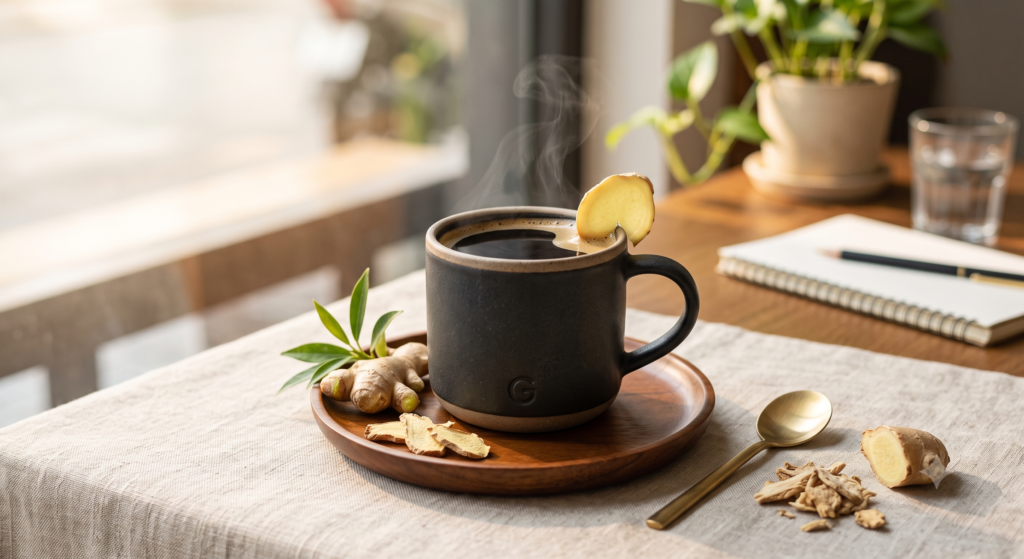
600 years of wisdom from Arab Qahwa, confirmed by modern science and preserved through cold-drying technology, K7 CAPHE is the perfect base to start your own healthy ginger-coffee habit. K7 CAPHE cold-dried coffee, Vietnamese Arabica (Cầu Đất & Khe Sanh) blended with Đắk Lắk Robusta, no additives, no flavorings. Add ginger, add energy start today.
Domestic customers: Buy now on our website or on e-commerce platforms: Buy now — Shopee K7 CAPHE
International customers: Please contact us for assistance: Contact K7 CAPHE
